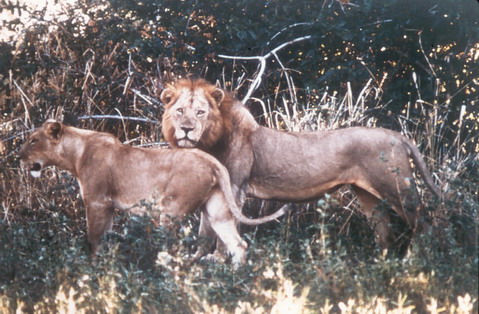
The Luangwa Valley is famous because of its walking safaris and this is without doubt the most thrilling way of seeing the bush and game.
South Luangwa National Park located at the tail end of the Great Rift Valley covers almost 3500 square miles of Zambia's pristine wilderness. The park consists of large amounts of woodland; miombo interspersed with grass lands in the north of the park and large stands of mature ebony forming deep shade along the banks of the river.
It is the Luangwa River, slowly meandering its way through the park from north to south, which gives the park it's particul+ar character. The soft soil and shallow gradient between the north and south of the park, combine to make ideal conditions for the formation of the oxbow lakes for which South Luangwa is well known. These Oxbows eventually silt up and grass over. This is one of the elements which produce such exceptional game viewing as well as some spectacular scenery; grassy glades, magnificent stands of ebony and tranquil lagoons teaming with birdlife. The Luangwa valley is also criss crossed with sand rivers and some shallow, clear water rivers that flow all year round.
Luangwa is well known for large populations of all the major African mammals (with the exception of Rhino, which were poached to extinction in the 80s - but are being reintroduced into North Luangwa). It has a reputation for some of the best leopard sightings in Africa. This is partly because of the ideal nature of the habitat which includes thick riverine bush with plenty of cover, lots of game and some large shady trees to lie up in and also, unlike many parks in Africa, night game driving is allowed.
There are bush buck, puku, kudu, impala, zebra (although not many in the south) the indigenous Thornicroft giraffe and all the main predators, lion, leopard etc, including wild dog and the smaller predators such as genet, civet, mongoose etc. The bird life is excellent and very vocal with the oxbows and river attracting a vast number of water birds.
The game viewing is outstanding up near Mfuwe (the park entrance) where the animals are very used to vehicles all year round. Mfuwe area is also quite busy, so you have to be prepared for other vehicles which you really notice at night because of the spot lights used on night drives. The lodges around Mfuwe are usually a base from which to go into the park and with the game being so habituated in the area, it is an idea to have a night or two at the beginning of the trip for some game drives and night drives and to then head off into the bush for the walking.
The north park and Nsefu sector which has camps such as Tena Tena, Nsefu, Kaingo, Mchenja and Tafika, is particularly beautiful with some really very impressive ebony groves. These tall and majestic trees give a dreamy dappled shade to almost lawn like grass underneath and are a haven for the game. The area is also generally more open with the huge Mtanda plains and hot springs/salt pans which certainly at the beginning of the season makes for slightly easier game viewing.
Most companies have a main lodge close to Mfuwe and then several bushcamps. These are all very individual and can very easily be combined with each other. There is also the option of doing mobile walking safaris where you walk from camp to camp.
The beauty of the bushcamps is that the day is slightly more relaxed, walking is the main activity, so you feel as though you have earned the huge amounts of delicious food on offer and you really do experience the smaller things of the bush as well as, of course, the thrill of coming across the bigger game on foot.
The main season for the Luangwa is between June and October and as the season goes on, so the Luangwa river dries up leaving vast sandbanks and huge pods of hippo, all jealously guarding their own territories. The Luangwa also boasts one of the largest population of crocodile in Africa and there are some very impressive beasts to be seen basking in the sun. The animals come to the main areas of water to drink, which is obviously the river, but is also some of the oxbow lagoons that lead off the river. The drier it gets the more the animals congregate and you can get herds of over 1000 buffalo. Just after the rains in October the Luangwa bursts into flower and there are areas full of wild jasmine and other flowering shrubs. The impala drop their young and it can be a magical time of year to visit.
The Luangwa is also stunning in the emerald season. The inland areas of the park are impassable because of flooding and much of the park is made up of black cotton soil which is a nightmare in the rains. However around Mfuwe there are some great roads and the animals all concentrate around the area as the rest of the park floods. They breed, so there are lots of babies around and the rivers fill up so you can do boating activities. The bush turns emerald green and it really is a beautiful time to travel. During this season there are a couple of bush camps still open where you area able to walk or do boating safaris.
http://www.naturalhighsafaris.com/zambia/subregion/south_luangwa.html
Wednesday, July 1, 2009

Monday, May 11, 2009
Luangwa Valley - Waiting for Thunder
In Zambia's Luangwa Valley, rain and river create a wildlife stronghold.
The Luangwa, one of the last major unaltered rivers in southern Africa, is the lifeline—and protector—of the valley it threads. Hippos, elephants, giraffes, lions, leopards, buffalo, and scores of other species flourish in the 20,000 square miles (52,000 square kilometers) of savanna-woodland watered by this 500-mile-long (800 kilometers) river. It is people that have been scarce here, especially beyond the town of Mfuwe. One reason is the Luangwa's annual flood cycle. Each year during the rains, the river reinvents the land. Swelling from a knee-deep stream to a roiling brown torrent, it carves new channels and spills into surrounding plains and woodlands, making this broad valley in eastern Zambia impassable by road for nearly half the year. For the other half, the waters retreat, leaving behind a rejuvenated landscape, which slowly parches through the long dry months that follow, when temperatures steadily climb until the land throbs with heat and thirst.
By late October, the floodplains are grazed to stubble, and a hot wind spins dust devils in the powdery soil. At dusk, hippos leave the river's last deep pools and melt into the darkness of the bush to forage. Some walk for miles to find food, and many die in this season of stress. One morning a small dead hippo floats by. Female hippos approach and nuzzle it, licking its skin, then moving away.
The seasons can be hard on the valley's wildlife, but people have been harder still. Hunting and poaching, even within the national parks, have drastically reduced hippo and elephant populations in the past, yet both have made a comeback, thanks in part to changes in enforcement and attitude. The resurgence is a sign of human tolerance and nature's resilience.
In November thunderheads build, bruised and dark, and the sky rumbles all night. One afternoon the earthy aroma of an approaching downpour blows in on a hard wind, and a cool gray curtain of rain sweeps the land, beating down in a torrent, rinsing dust from grasses and trees. Almost overnight, green shoots poke up from the earth. Bare mopani woodlands shimmer pink with new leaves. Lemon yellow blooms pop from acacias, and fragile spider lilies spring up in white drifts on the plains. Elephants and buffalo disperse into the uplands, where the browse is fresh. Impalas give birth, and zebras materialize from the bush with tiny foals.
Within days of the first rain, Abdim's storks appear overhead, wheeling in great gyres of thousands of birds. They are migrating south, and some Africans know them as bringers of rain. They touch down in a bobbing mass, moving together through the grass in a broad front, like fire, finding frogs and insects brought forth by the water. A new season is here.
http://ngm.nationalgeographic.com/2007/05/zambia-wildlife/eckstrom-text.html
The Luangwa, one of the last major unaltered rivers in southern Africa, is the lifeline—and protector—of the valley it threads. Hippos, elephants, giraffes, lions, leopards, buffalo, and scores of other species flourish in the 20,000 square miles (52,000 square kilometers) of savanna-woodland watered by this 500-mile-long (800 kilometers) river. It is people that have been scarce here, especially beyond the town of Mfuwe. One reason is the Luangwa's annual flood cycle. Each year during the rains, the river reinvents the land. Swelling from a knee-deep stream to a roiling brown torrent, it carves new channels and spills into surrounding plains and woodlands, making this broad valley in eastern Zambia impassable by road for nearly half the year. For the other half, the waters retreat, leaving behind a rejuvenated landscape, which slowly parches through the long dry months that follow, when temperatures steadily climb until the land throbs with heat and thirst.
By late October, the floodplains are grazed to stubble, and a hot wind spins dust devils in the powdery soil. At dusk, hippos leave the river's last deep pools and melt into the darkness of the bush to forage. Some walk for miles to find food, and many die in this season of stress. One morning a small dead hippo floats by. Female hippos approach and nuzzle it, licking its skin, then moving away.
The seasons can be hard on the valley's wildlife, but people have been harder still. Hunting and poaching, even within the national parks, have drastically reduced hippo and elephant populations in the past, yet both have made a comeback, thanks in part to changes in enforcement and attitude. The resurgence is a sign of human tolerance and nature's resilience.
In November thunderheads build, bruised and dark, and the sky rumbles all night. One afternoon the earthy aroma of an approaching downpour blows in on a hard wind, and a cool gray curtain of rain sweeps the land, beating down in a torrent, rinsing dust from grasses and trees. Almost overnight, green shoots poke up from the earth. Bare mopani woodlands shimmer pink with new leaves. Lemon yellow blooms pop from acacias, and fragile spider lilies spring up in white drifts on the plains. Elephants and buffalo disperse into the uplands, where the browse is fresh. Impalas give birth, and zebras materialize from the bush with tiny foals.
Within days of the first rain, Abdim's storks appear overhead, wheeling in great gyres of thousands of birds. They are migrating south, and some Africans know them as bringers of rain. They touch down in a bobbing mass, moving together through the grass in a broad front, like fire, finding frogs and insects brought forth by the water. A new season is here.
http://ngm.nationalgeographic.com/2007/05/zambia-wildlife/eckstrom-text.html
Saturday, May 9, 2009
Zambia's Incredible North Luangwa
Local communities to benefit from tourism ventures in their localities
A South African Non-Governmental Organisation (NGO) dealing with the promotion of tourism has pledged to work closely with the local people to promote tourism in the country.
Open Africa is an NGO that promotes the development of tourism corridor routs in six southern Africa countries namely South Africa, Namibia, Lesotho, Swaziland, Zambia and Mozambique,
Zambian route developer Cobus du Plessis said tourism can play a cardinal role towards alleviating poverty levels in the country if only local citizens participate in the implementation process.
Mr. Plessie told ZANIS in an interview in Lusaka that despite Zambia been a country that has attract many tourists through its vast natural resources, her citizen have continued to live in abject poverty.
He said it is for his reason that his organisation has targeted full participation of local communities as a way of encouraging them to invest in the tourism sector and mitigate the effects of the global economic crisis.
He said despite the global economic crisis, tourism has proved to be a sector that can still continue to contribute to the economic growth of the country if all citizens are allowed to take part.
Meanwhile, Mr. Plessie has challenged tour operators in the country to lower their charges and also market their products locally to attract more tourists and increase their revenue base.
In Zambia the NGO will open five new routes in Kasanka national park, North Luangwa, Mpika, Southern Kafue and the Barotse land.
And the Private Sector Development Association (PSDA) has encouraged the business community especially in the tourism industry to collaborate if they are to remain in business during the global economic meltdown.
PSDA chairperson Yusuf Dodia explained that by working together operators will come up with constructive solutions that will go a long way towards revamping the national economy.
Mr. Dodia further hinted that Zambian tourism industry still stands a great potential of overcoming the current economic challenges if it is properly managed.
http://www.lusakatimes.com/?p=11726
A South African Non-Governmental Organisation (NGO) dealing with the promotion of tourism has pledged to work closely with the local people to promote tourism in the country.
Open Africa is an NGO that promotes the development of tourism corridor routs in six southern Africa countries namely South Africa, Namibia, Lesotho, Swaziland, Zambia and Mozambique,
Zambian route developer Cobus du Plessis said tourism can play a cardinal role towards alleviating poverty levels in the country if only local citizens participate in the implementation process.
Mr. Plessie told ZANIS in an interview in Lusaka that despite Zambia been a country that has attract many tourists through its vast natural resources, her citizen have continued to live in abject poverty.
He said it is for his reason that his organisation has targeted full participation of local communities as a way of encouraging them to invest in the tourism sector and mitigate the effects of the global economic crisis.
He said despite the global economic crisis, tourism has proved to be a sector that can still continue to contribute to the economic growth of the country if all citizens are allowed to take part.
Meanwhile, Mr. Plessie has challenged tour operators in the country to lower their charges and also market their products locally to attract more tourists and increase their revenue base.
In Zambia the NGO will open five new routes in Kasanka national park, North Luangwa, Mpika, Southern Kafue and the Barotse land.
And the Private Sector Development Association (PSDA) has encouraged the business community especially in the tourism industry to collaborate if they are to remain in business during the global economic meltdown.
PSDA chairperson Yusuf Dodia explained that by working together operators will come up with constructive solutions that will go a long way towards revamping the national economy.
Mr. Dodia further hinted that Zambian tourism industry still stands a great potential of overcoming the current economic challenges if it is properly managed.
http://www.lusakatimes.com/?p=11726
Thursday, April 23, 2009
Trails in the Wilderness – or Wilderness Trails
If you have ever wondered about the origin of walking safaris in Africa, it might interest you to read what the legendary Norman Carr writes in one of his books – when he mentions the “game reserve” he is referring to the Luangwa Valley:
Trails in the Wilderness - Wilderness Trails
Not so many years ago I inaugurated a non-shooting type of safari with a difference, which I called ‘wilderness trail’. (Later known as “Wilderness Trails”.) It is virtually a walking tour in the game reserve, miles away from habitation or man-made tracks, with a trail of porters carrying one’s requirements in the traditional African manner; in fact little changed from the methods of Livingstone and Stanley.
Such a safari always brings back to me nostalgic memories of earlier times when the only means of transportation was on foot. It helps to recall, too, a sense of completeness, of peaceful unity with nature, and to conjure up idyllic scenes of animals grazing undisturbed in peaceful riverine glades, where there is always time to pause and study their uninhibited actions without any feelings of guilt because you are wasting somebody else’s time.
Time nowadays is a commodity that increases in value with each succeeding year. Every hour not spent rushing from one place to another seems to be a debit entry which will have to be accounted for on the Day of Reckoning. Time was invented by man and he has now made himself a slave to it. It is a pity, for it is impossible, traveling at thirty miles an hour, to get to know an area intimately and to reflect on the intricate relationship between the soils, the vegetation and the fauna.
Africa has now been opened up to the four-wheel-drive vehicle and a journey that used to take a month can now be accomplished in a day or so. Very little touring on foot is undertaken any more, even by field officers, who now take Unimogs and Halflingers into areas too much even for Land Rovers – horrible dinky-toy contraptions consisting of a platform on wheels propelled by noisy, smelly engines from which every animal flees.
How peaceful and revealing it is by contrast to sit in camp at the end of a day’s trek and watch, for example, a pair of white-headed plovers sharing their nesting duties. Their nest is a mere depression in the sandy riverbed – I think perhaps a ‘scrape’ is a better description – and they make no attempt to embellish it. The four cryptic buff-colored eggs are cunningly camouflaged and practically impossible to see against the background of sand and stones, which the bird has selected, as its nesting site. If anyone should approach, the plover will cheep and twitter hysterically, sometimes even dive-bomb you and then fly off to a patch of beach some distance off, performing all kinds of peculiar antics in order to divert your attention from the nest. How can you possibly enjoy these little domestic displays from the seat of a motorcar?
Then again, to talk around the campfire to men who have now become individuals rather than a line of porters carrying their burdens is an experience in itself. For any one of them has a lifetime of knowledge and anecdotes, which he is only too ready to impart. How else can you get to know the intriguing customs and traditions of these simple and natural people? How else unravel the apparently inextricable confusion between their own astute observations and their naïve acceptance of folklore? (Norman was deeply respected by the local people – and he had learned to speak the local language.)
It is to these trails that I look back with great pleasure. They are difficult to capture exactly, but I would like to give others an opportunity to savor something of the excitement, the glamour and the atmosphere of Africa as it used to be.
On this sort of safari I like to restrict my guests to four, for it is difficult for one leader to look after more than this number without a party becoming a crowd. Usually we break camp early in the morning, for that is the time when the animals are most active. You might catch sight of some of the night prowlers returning late to their hideout – a honey badger, a hyena, or even a lion before it settles down in the shade to laze away the heat-laden hours until the sun’s slanting rays become cool enough for him once again to pad his haughty way along the forest tracks.
http://www.fundednfree.com/normancarr.html
Trails in the Wilderness - Wilderness Trails
Not so many years ago I inaugurated a non-shooting type of safari with a difference, which I called ‘wilderness trail’. (Later known as “Wilderness Trails”.) It is virtually a walking tour in the game reserve, miles away from habitation or man-made tracks, with a trail of porters carrying one’s requirements in the traditional African manner; in fact little changed from the methods of Livingstone and Stanley.
Such a safari always brings back to me nostalgic memories of earlier times when the only means of transportation was on foot. It helps to recall, too, a sense of completeness, of peaceful unity with nature, and to conjure up idyllic scenes of animals grazing undisturbed in peaceful riverine glades, where there is always time to pause and study their uninhibited actions without any feelings of guilt because you are wasting somebody else’s time.
Time nowadays is a commodity that increases in value with each succeeding year. Every hour not spent rushing from one place to another seems to be a debit entry which will have to be accounted for on the Day of Reckoning. Time was invented by man and he has now made himself a slave to it. It is a pity, for it is impossible, traveling at thirty miles an hour, to get to know an area intimately and to reflect on the intricate relationship between the soils, the vegetation and the fauna.
Africa has now been opened up to the four-wheel-drive vehicle and a journey that used to take a month can now be accomplished in a day or so. Very little touring on foot is undertaken any more, even by field officers, who now take Unimogs and Halflingers into areas too much even for Land Rovers – horrible dinky-toy contraptions consisting of a platform on wheels propelled by noisy, smelly engines from which every animal flees.
How peaceful and revealing it is by contrast to sit in camp at the end of a day’s trek and watch, for example, a pair of white-headed plovers sharing their nesting duties. Their nest is a mere depression in the sandy riverbed – I think perhaps a ‘scrape’ is a better description – and they make no attempt to embellish it. The four cryptic buff-colored eggs are cunningly camouflaged and practically impossible to see against the background of sand and stones, which the bird has selected, as its nesting site. If anyone should approach, the plover will cheep and twitter hysterically, sometimes even dive-bomb you and then fly off to a patch of beach some distance off, performing all kinds of peculiar antics in order to divert your attention from the nest. How can you possibly enjoy these little domestic displays from the seat of a motorcar?
Then again, to talk around the campfire to men who have now become individuals rather than a line of porters carrying their burdens is an experience in itself. For any one of them has a lifetime of knowledge and anecdotes, which he is only too ready to impart. How else can you get to know the intriguing customs and traditions of these simple and natural people? How else unravel the apparently inextricable confusion between their own astute observations and their naïve acceptance of folklore? (Norman was deeply respected by the local people – and he had learned to speak the local language.)
It is to these trails that I look back with great pleasure. They are difficult to capture exactly, but I would like to give others an opportunity to savor something of the excitement, the glamour and the atmosphere of Africa as it used to be.
On this sort of safari I like to restrict my guests to four, for it is difficult for one leader to look after more than this number without a party becoming a crowd. Usually we break camp early in the morning, for that is the time when the animals are most active. You might catch sight of some of the night prowlers returning late to their hideout – a honey badger, a hyena, or even a lion before it settles down in the shade to laze away the heat-laden hours until the sun’s slanting rays become cool enough for him once again to pad his haughty way along the forest tracks.
http://www.fundednfree.com/normancarr.html
Thursday, March 26, 2009
Luangwa Valley
To anyone who has ever visited the Luangwa Valley, the following blog entry by PH Craig Doria with the headline "Puff Adders, Cobras and Floodwaters" will fascinate. Read the original posting - link at the end of this story.
"There is a huge wild valley in Zambia called the Luangwa Valley that just cannot be tamed. Of course, people have lived there since time immemorial, but they were unable to modify their world to any significant degree because the environment was just too tough for them.
In the 1790s chief Kazembe of the Lunda encouraged the first Europeans, the Portuguese, to open trade routes from Tete into Luangwa. The Portuguese found the place to be inhospitable and dangerous. They were plagued by malaria and troubled by wild animals.
In time, however, the Portuguese government granted estates throughout the Luangwa Valley, called Prazos, to families of mostly mixed Goan and African parentage. The Prazo owners formed their own bands of mercenaries and fought each other in this wild, lawless country. The ‘armies’ became known as the Chikunda, which is what the current inhabitants of the Luangwa Valley are often known as. By the 1890s Jose d’Araujo Lobo was the most powerful Prazo owner with an army of 12,000 men.
The strongest challenge to the Portuguese came from the Ngoni, an offshoot of the Zulu nation who were moving up from the south. The Arab traders from the coast also challenged them. But the British were the ones who finally forced the Portuguese to leave the valley, chased out the Arabs, and conquered the Ngoni.
What is particularly interesting about this rich history is that today one sees very little physical evidence of the Luangwa Valley’s past.
It has all been eaten by termites.
And things have not changed very much. We all built houses there, and lodges, and camps, and every so often the Valley (as it is affectionately known) reminds us that it is its own master. Every rainy season in fact.
I have never seen such active termites as in the Luangwa Valley. During the rains it seems that they go onto steroids and quite literally eat everything. We used to walk up to the bar at the nearby lodge in the evenings, and by the time we returned home the termites would have built a series of small towers coming up out of all the small cracks in the concrete floors. These humble beginnings of termite mounds could be four inches high when we caught them by surprise building away in our lounge. A colleague living nearby had a large personal library and kept each book in its own separate ziplock bag in order to keep them away from the busy jaws of the termites. They ate the back wall of our house and the thatch roof.
Snakes also come out aplenty during the rains. Big ones, small ones, medium-sized ones, up to five of them a day around the house and lodge. We had one particularly large cobra that seemed to live in a huge termite mound outside our house. Several evenings while we were drinking at the bar, our night watchman would come running up to tell us that this large snake was in the house and wreaking havoc. The snake was able to enter through the poorly crafted thatch roof, which was not good when our children were all tucked up sleeping in their beds. We would go down and usually find nothing. On one occasion, though, we found all the bottles on the bathroom shelf knocked to the ground. Then one day I found him in the roof of the outside long-drop and shot him from the inside with a 12-bore shotgun. It wasn’t very good for the roof.
Everyone tried to stay open year round and struggled through each rainy season with a dribble of wet tourists. Some new operators arrived, and one actually said to me in the bar late one night, “I’m going to show you guys how to run a proper safari business here.”
He sold his camp a couple of years later to an unsuspecting romantic.
There are a very small handful of safari operators and professional hunters who have lived in this valley for a long time. Adrian Carr is one of those people. Some readers might know Adrian due to a well-published, but unfortunate, accident with a fine Rigby rifle back in the 1970s. But that story has been documented elsewhere.
We had our small ramshackle collection of huts about 200 yards from Adrian’s house, and I apprenticed under him when I was doing my PH licence. So we got to spend a lot of time together in the bush.
We had a frightening encounter with a snake some years back. A buffalo had been wounded and we were following it. We spooked it twice, and each time we became a little more tense. Finally it entered the thicket along a dry, sand river. In we went and soon realized that its tracks were meandering back and forth and crossing themselves. We became even more tense. Eventually we found ourselves in a large stand of tall hyphereania. The two trackers were ahead of us and bent double, faces almost to the ground following the tiny drops of blood. We were behind, peering for all we were worth into the thick bush for any sign of the buffalo. Safety catches were probably off and fingers were probably curling ever so lightly around triggers. The buffalo just had to be close.
And then the two trackers turned into something molten and flowed back past us with such speed that we were slightly distracted by the sheer grace of it. My first conscious thought was, “OK, here it comes.” But there was no noise. No crashing of undergrowth and no heavy thumping of hooves.
And then Adrian leapt back, one nanosecond behind the trackers. That left me … brave … to face the music, and thinking, “That’s unlike Adrian.” And then I leapt back another nanosecond behind Adrian. And in that instant of us all leaping back we saw in front of us a spectre from every universal nightmare from every age of horror.
A seven-foot-long, two-headed puff adder was striking at us with both its hideous mouths agape and all four hideous fangs dripping with yellow venom. After leaping we staggered backwards, tripping over each other and stumbling to a rest several yards back. The buffalo was forgotten.
It took some time and a lot of confused chattering between all four of us:
“Huge snake!”
“Two heads!”
“Striking!”
“Both heads!”
“Let’s have a cigarette.”
But finally we went back to see the two-headed beast. By now, being a snake, and not very smart, it had settled down to doing what it had been doing before we had stalked so quietly onto it.
There, in an excited state of sexual bliss, and still joined at the vent, were two extremely large mating puff adders. With a long stick we hooked one up and it came with its partner attached. Inseparable they were.
But back to the story at hand.
Everyone with any sense knew that sooner or later the Luangwa River would flood properly. But we all built camps on the river. Of course!
Then in the rains of 2007 the river came up. Then it came up some more. “Oh it’s not too bad,” everyone said, “It’s good to have a proper rainy season for a change. This is just how the river should look at this time of year.”
And then overnight it rose even higher, and all the camps along the river were flooded. Water came up high enough that it flowed through windows and into well-decorated chalets. The lodges were all abandoned while everyone waited for the water to drop. And while everyone felt sorry for the lodge owners who lost a lot, it was really the local villagers who lost everything. These descendents of the Chikunda fighters had houses built of mud mostly along the banks of the Luangwa River’s tributaries. They all disappeared and people were left, standing on the edge of the one raised road that runs to the airport, with pathetic collections of what they had managed to salvage.
After a time the water started to go down, and the safari operators slowly started to move cautiously back in. The buildings were all awash with mud and slush. Adrian came back early and waded through what was normally dry land but was now a flooding Luangwa River, to get to his house that was on a slightly raised piece of land and thus almost dry. The water had receded enough to be lapping at the kitchen step.
Adrian and his partner Christina waded through flowing floodwater to their house and climbed the back step to survey the disaster. The inside of the house was, of course, a muddy mess, as they sloshed disconsolately from one room to the next. And in the main bedroom they found a large, black-necked spitting cobra.
One has to have seen a big black-necked spitting cobra to really know what a powerful presence it has. They are often over six-feet-long, and jet black. So jet black that they shine the deepest blue in sunlight. The scales seem as large as bathroom tiles, and they can be as thick as your wrist. And then they always turn to look at you when you approach. This is the most disconcerting. When a snake turns its head to watch you and fixes those dark eyes on you, you stop to think. The head is thick, rounded, blunt, muscular and … scary. The venom is a powerful cocktail of cytotoxins and neurotoxins and, of course, it not only bites but will also spit this venom into your eyes. I would think that after the black mamba it must be the most awe-inspiring African snake. So, of course, everyone is scared of them.
It is easy to imagine then, the fright they must have got when they walked into their bedroom and encountered the cobra. Adrian had a .22 rifle with him, and so he shot the snake. Then he shot it again, as you do with a large cobra in your bedroom. Then he carried the corpse through the muddy house draped over a muddy broom and left it on the kitchen step. He and Christina continued their house survey.
A few minutes later they returned and the snake had gone. They still had to wade back through the water where the snake had disappeared, so Adrian decided he had to find it. So he stood on the kitchen step, leaning out and hooking into the muddy water with the broom. About three metres away a single black coil of cobra rose slowly out of the water and disappeared in a gentle swirl as the current took it further away.
In every situation like this, there is a moment at which one could have backed off and saved oneself a useful place in the theory which Darwin propounds. But all too often we show that, indeed, we could easily be removed from the gene pool with no detrimental effect to the human race.
So into the water Adrian went to go and hook the snake and remove it from where he and Christina had to wade. And then a little deeper, above the knees fishing with the broom until, “Bugger me if I don’t feel it coiling around my leg … a couple of full, tight coils. So, like a Dinka warrior I lift my leg … slowly … stork-like from the water … and all six feet of shiny black snake is around my leg.” And if that wasn’t bad enough to send one to never-ending therapy, he continues: “The mouth is partially open, right up against my calf.”
Adrian had visions of dying cobras that we have seen bite pieces of wood or even themselves, but he somehow managed “to reach down ever so slowly and grab it just behind the head, all the while expecting a full bite.”
And his story ends thus “… I was shaking like a leaf. We then had a nice cup of tea (with lots of rum).”
http://russelhunter.wordpress.com/2009/03/26/puff-adders-cobras-and-floodwaters/
"There is a huge wild valley in Zambia called the Luangwa Valley that just cannot be tamed. Of course, people have lived there since time immemorial, but they were unable to modify their world to any significant degree because the environment was just too tough for them.
In the 1790s chief Kazembe of the Lunda encouraged the first Europeans, the Portuguese, to open trade routes from Tete into Luangwa. The Portuguese found the place to be inhospitable and dangerous. They were plagued by malaria and troubled by wild animals.
In time, however, the Portuguese government granted estates throughout the Luangwa Valley, called Prazos, to families of mostly mixed Goan and African parentage. The Prazo owners formed their own bands of mercenaries and fought each other in this wild, lawless country. The ‘armies’ became known as the Chikunda, which is what the current inhabitants of the Luangwa Valley are often known as. By the 1890s Jose d’Araujo Lobo was the most powerful Prazo owner with an army of 12,000 men.
The strongest challenge to the Portuguese came from the Ngoni, an offshoot of the Zulu nation who were moving up from the south. The Arab traders from the coast also challenged them. But the British were the ones who finally forced the Portuguese to leave the valley, chased out the Arabs, and conquered the Ngoni.
What is particularly interesting about this rich history is that today one sees very little physical evidence of the Luangwa Valley’s past.
It has all been eaten by termites.
And things have not changed very much. We all built houses there, and lodges, and camps, and every so often the Valley (as it is affectionately known) reminds us that it is its own master. Every rainy season in fact.
I have never seen such active termites as in the Luangwa Valley. During the rains it seems that they go onto steroids and quite literally eat everything. We used to walk up to the bar at the nearby lodge in the evenings, and by the time we returned home the termites would have built a series of small towers coming up out of all the small cracks in the concrete floors. These humble beginnings of termite mounds could be four inches high when we caught them by surprise building away in our lounge. A colleague living nearby had a large personal library and kept each book in its own separate ziplock bag in order to keep them away from the busy jaws of the termites. They ate the back wall of our house and the thatch roof.
Snakes also come out aplenty during the rains. Big ones, small ones, medium-sized ones, up to five of them a day around the house and lodge. We had one particularly large cobra that seemed to live in a huge termite mound outside our house. Several evenings while we were drinking at the bar, our night watchman would come running up to tell us that this large snake was in the house and wreaking havoc. The snake was able to enter through the poorly crafted thatch roof, which was not good when our children were all tucked up sleeping in their beds. We would go down and usually find nothing. On one occasion, though, we found all the bottles on the bathroom shelf knocked to the ground. Then one day I found him in the roof of the outside long-drop and shot him from the inside with a 12-bore shotgun. It wasn’t very good for the roof.
Everyone tried to stay open year round and struggled through each rainy season with a dribble of wet tourists. Some new operators arrived, and one actually said to me in the bar late one night, “I’m going to show you guys how to run a proper safari business here.”
He sold his camp a couple of years later to an unsuspecting romantic.
There are a very small handful of safari operators and professional hunters who have lived in this valley for a long time. Adrian Carr is one of those people. Some readers might know Adrian due to a well-published, but unfortunate, accident with a fine Rigby rifle back in the 1970s. But that story has been documented elsewhere.
We had our small ramshackle collection of huts about 200 yards from Adrian’s house, and I apprenticed under him when I was doing my PH licence. So we got to spend a lot of time together in the bush.
We had a frightening encounter with a snake some years back. A buffalo had been wounded and we were following it. We spooked it twice, and each time we became a little more tense. Finally it entered the thicket along a dry, sand river. In we went and soon realized that its tracks were meandering back and forth and crossing themselves. We became even more tense. Eventually we found ourselves in a large stand of tall hyphereania. The two trackers were ahead of us and bent double, faces almost to the ground following the tiny drops of blood. We were behind, peering for all we were worth into the thick bush for any sign of the buffalo. Safety catches were probably off and fingers were probably curling ever so lightly around triggers. The buffalo just had to be close.
And then the two trackers turned into something molten and flowed back past us with such speed that we were slightly distracted by the sheer grace of it. My first conscious thought was, “OK, here it comes.” But there was no noise. No crashing of undergrowth and no heavy thumping of hooves.
And then Adrian leapt back, one nanosecond behind the trackers. That left me … brave … to face the music, and thinking, “That’s unlike Adrian.” And then I leapt back another nanosecond behind Adrian. And in that instant of us all leaping back we saw in front of us a spectre from every universal nightmare from every age of horror.
A seven-foot-long, two-headed puff adder was striking at us with both its hideous mouths agape and all four hideous fangs dripping with yellow venom. After leaping we staggered backwards, tripping over each other and stumbling to a rest several yards back. The buffalo was forgotten.
It took some time and a lot of confused chattering between all four of us:
“Huge snake!”
“Two heads!”
“Striking!”
“Both heads!”
“Let’s have a cigarette.”
But finally we went back to see the two-headed beast. By now, being a snake, and not very smart, it had settled down to doing what it had been doing before we had stalked so quietly onto it.
There, in an excited state of sexual bliss, and still joined at the vent, were two extremely large mating puff adders. With a long stick we hooked one up and it came with its partner attached. Inseparable they were.
But back to the story at hand.
Everyone with any sense knew that sooner or later the Luangwa River would flood properly. But we all built camps on the river. Of course!
Then in the rains of 2007 the river came up. Then it came up some more. “Oh it’s not too bad,” everyone said, “It’s good to have a proper rainy season for a change. This is just how the river should look at this time of year.”
And then overnight it rose even higher, and all the camps along the river were flooded. Water came up high enough that it flowed through windows and into well-decorated chalets. The lodges were all abandoned while everyone waited for the water to drop. And while everyone felt sorry for the lodge owners who lost a lot, it was really the local villagers who lost everything. These descendents of the Chikunda fighters had houses built of mud mostly along the banks of the Luangwa River’s tributaries. They all disappeared and people were left, standing on the edge of the one raised road that runs to the airport, with pathetic collections of what they had managed to salvage.
After a time the water started to go down, and the safari operators slowly started to move cautiously back in. The buildings were all awash with mud and slush. Adrian came back early and waded through what was normally dry land but was now a flooding Luangwa River, to get to his house that was on a slightly raised piece of land and thus almost dry. The water had receded enough to be lapping at the kitchen step.
Adrian and his partner Christina waded through flowing floodwater to their house and climbed the back step to survey the disaster. The inside of the house was, of course, a muddy mess, as they sloshed disconsolately from one room to the next. And in the main bedroom they found a large, black-necked spitting cobra.
One has to have seen a big black-necked spitting cobra to really know what a powerful presence it has. They are often over six-feet-long, and jet black. So jet black that they shine the deepest blue in sunlight. The scales seem as large as bathroom tiles, and they can be as thick as your wrist. And then they always turn to look at you when you approach. This is the most disconcerting. When a snake turns its head to watch you and fixes those dark eyes on you, you stop to think. The head is thick, rounded, blunt, muscular and … scary. The venom is a powerful cocktail of cytotoxins and neurotoxins and, of course, it not only bites but will also spit this venom into your eyes. I would think that after the black mamba it must be the most awe-inspiring African snake. So, of course, everyone is scared of them.
It is easy to imagine then, the fright they must have got when they walked into their bedroom and encountered the cobra. Adrian had a .22 rifle with him, and so he shot the snake. Then he shot it again, as you do with a large cobra in your bedroom. Then he carried the corpse through the muddy house draped over a muddy broom and left it on the kitchen step. He and Christina continued their house survey.
A few minutes later they returned and the snake had gone. They still had to wade back through the water where the snake had disappeared, so Adrian decided he had to find it. So he stood on the kitchen step, leaning out and hooking into the muddy water with the broom. About three metres away a single black coil of cobra rose slowly out of the water and disappeared in a gentle swirl as the current took it further away.
In every situation like this, there is a moment at which one could have backed off and saved oneself a useful place in the theory which Darwin propounds. But all too often we show that, indeed, we could easily be removed from the gene pool with no detrimental effect to the human race.
So into the water Adrian went to go and hook the snake and remove it from where he and Christina had to wade. And then a little deeper, above the knees fishing with the broom until, “Bugger me if I don’t feel it coiling around my leg … a couple of full, tight coils. So, like a Dinka warrior I lift my leg … slowly … stork-like from the water … and all six feet of shiny black snake is around my leg.” And if that wasn’t bad enough to send one to never-ending therapy, he continues: “The mouth is partially open, right up against my calf.”
Adrian had visions of dying cobras that we have seen bite pieces of wood or even themselves, but he somehow managed “to reach down ever so slowly and grab it just behind the head, all the while expecting a full bite.”
And his story ends thus “… I was shaking like a leaf. We then had a nice cup of tea (with lots of rum).”
http://russelhunter.wordpress.com/2009/03/26/puff-adders-cobras-and-floodwaters/
Wednesday, March 25, 2009
World Big Cat Safaris
The new sister company of the successful World Primate Safaris has now been launched.
World Primate Safaris is a very successful specialist tour operator that sends people out ot Africa and Asia to track some of the most endangered primates in the world, and at the end of 2008 their sister company World Big Cat Safaris was launched.
Again, World Big Cat Safaris relies on their expert knowledge of the areas they specialise in to
make themselves different to everyone else. The 3 tour consultants in the office are ex tour leaders and guides from the various regions of Africa and so their first hand knowledge is second to none.
World Big Cat Safaris are specialists safaris to track the Big Cats of the world. They tailor adventure or luxury safaris with a selection of mobile camps and luxury lodges in some of the best wildlife areas in the world...Safari Holidays are our speciality whether it be a tiger safari in India or an African Safari to Botswana.
World Big Cat Safaris donates a percentage of each safari sold towards the conservation of endangered Big Cats throughout the world. Holidays can be tailored to meet each specific clients requirements including luxury honeymoon safaris, family African Safaris, walking safaris and much, much, more.
World Big Cat Safaris offers a selection of traditional Kenya Safari Holidays to see the savannah game of the Masai Mara. Kenya is at the forefront of wildlife conservation and community led initiatives and is perfect for a honeymoon safari or family safari and beach relaxation.
Tanzania is a prime wildlife safari destination. Your Tanzania Safari can combine the wonderful Serengeti National Park, the stunning Ngorongoro Crater and the pristine tropical islands of Zanzibar or Pemba. Your Tanzania Safari should make the most of the fantatsic selection of luxury lodges and camps that are now available throughout Tanzania.
Wildlife in Botswana is the highlight. The Okavango Delta and Chobe National Park provide the ultimate locations for your Botswana Safari. An expensive safari destination, Botswana provides luxury safari accommodation with unique access to private concessions providing the ultimate in wildlife safari viewing.
Your South African Safari can consist of a multitude of interesting activities including a wildlife safari in the Kruger National Park or its surrounding private concessions, the winelands of the Cape and some of the most scenic coastal drives in the world. A luxury South African safari is actually very good value for money in comparison to other African Safari destinations.
Zambia Safaris are up and coming as Zambia is new as an African Safari destination. Your Zambia Safari will concentrate primarily on a few areas, including South Luangwa Valley, Lower Zambezi, Kafue National Park and the renowned Victoria Falls. Walking Safaris are also a highlight with some of the best African Safari guides available on the continent.
A Tiger Safari in India is the highlight of any wildlife enthusiast’s career. A typical India safari may consist of the one horned rhinos of Kaziranga, the Asiatic Lions of Sasan Gir National Park and of course the endangered but majestic Bengal Tigers. The best places to visit for your India Tiger Safari include the historic Corbett National Park, Ranthambhore, Bandhavgarh and the tiger park of Kanha.
The large predators are what people want to see when they go on a safari and with World Big Cat safaris they will put you in the best place to maximize your chances of seeing them.
http://www.pr-inside.com/world-big-cat-safaris-which-is-r1137746.htm
World Primate Safaris is a very successful specialist tour operator that sends people out ot Africa and Asia to track some of the most endangered primates in the world, and at the end of 2008 their sister company World Big Cat Safaris was launched.
Again, World Big Cat Safaris relies on their expert knowledge of the areas they specialise in to
make themselves different to everyone else. The 3 tour consultants in the office are ex tour leaders and guides from the various regions of Africa and so their first hand knowledge is second to none.
World Big Cat Safaris are specialists safaris to track the Big Cats of the world. They tailor adventure or luxury safaris with a selection of mobile camps and luxury lodges in some of the best wildlife areas in the world...Safari Holidays are our speciality whether it be a tiger safari in India or an African Safari to Botswana.
World Big Cat Safaris donates a percentage of each safari sold towards the conservation of endangered Big Cats throughout the world. Holidays can be tailored to meet each specific clients requirements including luxury honeymoon safaris, family African Safaris, walking safaris and much, much, more.
World Big Cat Safaris offers a selection of traditional Kenya Safari Holidays to see the savannah game of the Masai Mara. Kenya is at the forefront of wildlife conservation and community led initiatives and is perfect for a honeymoon safari or family safari and beach relaxation.
Tanzania is a prime wildlife safari destination. Your Tanzania Safari can combine the wonderful Serengeti National Park, the stunning Ngorongoro Crater and the pristine tropical islands of Zanzibar or Pemba. Your Tanzania Safari should make the most of the fantatsic selection of luxury lodges and camps that are now available throughout Tanzania.
Wildlife in Botswana is the highlight. The Okavango Delta and Chobe National Park provide the ultimate locations for your Botswana Safari. An expensive safari destination, Botswana provides luxury safari accommodation with unique access to private concessions providing the ultimate in wildlife safari viewing.
Your South African Safari can consist of a multitude of interesting activities including a wildlife safari in the Kruger National Park or its surrounding private concessions, the winelands of the Cape and some of the most scenic coastal drives in the world. A luxury South African safari is actually very good value for money in comparison to other African Safari destinations.
Zambia Safaris are up and coming as Zambia is new as an African Safari destination. Your Zambia Safari will concentrate primarily on a few areas, including South Luangwa Valley, Lower Zambezi, Kafue National Park and the renowned Victoria Falls. Walking Safaris are also a highlight with some of the best African Safari guides available on the continent.
A Tiger Safari in India is the highlight of any wildlife enthusiast’s career. A typical India safari may consist of the one horned rhinos of Kaziranga, the Asiatic Lions of Sasan Gir National Park and of course the endangered but majestic Bengal Tigers. The best places to visit for your India Tiger Safari include the historic Corbett National Park, Ranthambhore, Bandhavgarh and the tiger park of Kanha.
The large predators are what people want to see when they go on a safari and with World Big Cat safaris they will put you in the best place to maximize your chances of seeing them.
http://www.pr-inside.com/world-big-cat-safaris-which-is-r1137746.htm
Tuesday, March 3, 2009
Both good and bad news for rhinos has been reported from Zambia this week.
Starting with the positive, WWF is working to re-introduce Black rhino into the country’s wildlife areas after an absence of 30 years.
Until the 1970’s, Zambia was a black rhino stronghold with a single Luangwa National Park providing sanctuary for around 20,000 animals alone. However by the end of the 1980’s they were all gone - shot for their horns which were sold to ornamental dagger makers in Yemen and traditional Chinese herbal practitioners in the Far East.
However, a small group of Black rhino were recently re-introduced into Luangwa from South Africa and WWF now plans to expand the re-introduction programme with animals from Kenya, Namibia and Zimbabwe.
James Phiri from WWF said: “We are supporting the re-stocking and sustenance of the Black Rhino to make sure that the population of the Black Rhino is raised.”
However, whilst this is hugely positive news, there was also bad news yesterday as a group pf poachers were arrested in Kafue National Park with 5 rhino horns and 72 elephant tusks.
Zambia Wildlife Authority’s, Dr Saiwana, suspects that the animals were killed in neighbouring countries not Zambia: “The 23 black rhinoceros in North Luangwa national park are safe”.
However, the incident highlights the continued threat to rhinos across Africa and the need for continued conservation efforts to ensure the species full recovery.
http://www.goallover.org/?p=1800
Until the 1970’s, Zambia was a black rhino stronghold with a single Luangwa National Park providing sanctuary for around 20,000 animals alone. However by the end of the 1980’s they were all gone - shot for their horns which were sold to ornamental dagger makers in Yemen and traditional Chinese herbal practitioners in the Far East.
However, a small group of Black rhino were recently re-introduced into Luangwa from South Africa and WWF now plans to expand the re-introduction programme with animals from Kenya, Namibia and Zimbabwe.
James Phiri from WWF said: “We are supporting the re-stocking and sustenance of the Black Rhino to make sure that the population of the Black Rhino is raised.”
However, whilst this is hugely positive news, there was also bad news yesterday as a group pf poachers were arrested in Kafue National Park with 5 rhino horns and 72 elephant tusks.
Zambia Wildlife Authority’s, Dr Saiwana, suspects that the animals were killed in neighbouring countries not Zambia: “The 23 black rhinoceros in North Luangwa national park are safe”.
However, the incident highlights the continued threat to rhinos across Africa and the need for continued conservation efforts to ensure the species full recovery.
http://www.goallover.org/?p=1800
Subscribe to:
Posts (Atom)