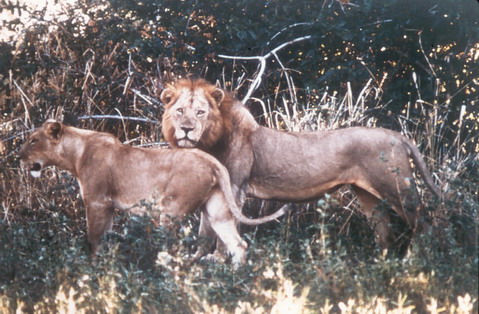
Exhilarating to the point of addiction... that’s what walking with big game feels like if you’ve only ever seen animals from a safari vehicle.
Expert Africa offers a safari experience in the South Luangwa - Zambia’s premier park - whereby the second person essentially safaris for free.
Staying in at least two of Norman Carr Safari’s five well-established camps (Kapani, Kakuli and Mchenja, which offer a mixture of driving and walking activities; and Luwi and Nsolo, focusing almost solely on walking safaris), you’ll enjoy top-notch guiding, learn to sniff out elephants and to follow the tracks of hyenas.
You don’t need to be especially fit to walk in Zambia – the walks are about taking time to spot the signs of the wildlife and to learn how the ecosystems work.
And you’ll be accompanied not only by a professional guide, but also an armed game scout, and often a tea-bearer carrying refreshments. Walks cater for a maximum of six guests, but between two and five is the norm.
Originally appeared here
Showing posts with label wilderness trails. Show all posts
Showing posts with label wilderness trails. Show all posts
Sunday, August 26, 2012

Sunday, May 2, 2010
Walking Safaris in Zambia
I have personally experienced the Luangwa Valley, so I am happy to refer to this post:
Many people have different expectations from a safari to the African continent, some enjoy relaxing in five star accommodation with spas and the latest treatments, with world class dining and fine wines, whilst others want to totally immerse themselves deep in the bush.
Either experience will afford high quality game viewing but the latter most definitely provides a real sense of Africa “unplugged”.
Walking safaris were pioneered in Zambia’s South Luangwa by the renowned Norman Carr over fifty years ago and today his legacy is a small selection of high quality bush camps which are platforms for exciting foot safaris.
Bush camps tend to be much smaller than traditional safari lodges, taking between 6 to 10 guests at a time and more traditional in design with a handful of thatched cottages, usually opening onto a tranquil bend of the Luangwa River.
The key to any safari in Africa is the quality of the guiding and Zambian guides are amongst the very best - taking guests out on foot requires a high level of concentration and sensory perception.
Imagine coming across all of the wildlife you would see from the comfort of your seat in a large 4x4 vehicle, now imagine the same experience on foot. Safety is paramount and the experience is unforgettable.
My very first walking safari in the South Luangwa brought our small group to within 100 feet of a pair of mating leopards!
Zambia’s National Parks are well established - and during the dry season - which runs between May and the end of October, the South Luangwa provides exceptional game viewing.
Large breeding herds of elephant trawl through the mopane forests , along with even larger herds of buffalo. Large prides of lion defend their territories from the local competition and the chances of seeing leopard in the wild are perhaps higher than in any other location in Africa.
Many different species of antelope thrive in Zambia as well as the more unusual Thorneycroft’s Giraffe and Cookson’s Wildebeest.
The Luangwa River supports high concentrations of hippopotamus and as the dry season progresses and the river shrinks, it is not uncommon to see pods of several hundred hippos gathering in the deeper channels.
Strategically placed photographic hides provide exceptional opportunities to get close to these large river horses and observe their behaviour.
Zambia is easily accessible with direct flights from the UK into the capital, Lusaka. A short flight then takes you to the small town of Mfuwe which is the gateway to a safari in the South Luangwa.
And as you make your way to camp, the spectacular beauty of one of Africa’s last true wilderness areas unfolds, drawing you in and holding your imagination captive for the next few days.
If a walking safari in Zambia sounds like the style of safari you would enjoy, make sure you talk with someone who has visited the area and can provide an impartial insight into the best location and camp for you depending on your expectations, as some camps are more rustic than others.
Read the original here:
Many people have different expectations from a safari to the African continent, some enjoy relaxing in five star accommodation with spas and the latest treatments, with world class dining and fine wines, whilst others want to totally immerse themselves deep in the bush.
Either experience will afford high quality game viewing but the latter most definitely provides a real sense of Africa “unplugged”.
Walking safaris were pioneered in Zambia’s South Luangwa by the renowned Norman Carr over fifty years ago and today his legacy is a small selection of high quality bush camps which are platforms for exciting foot safaris.
Bush camps tend to be much smaller than traditional safari lodges, taking between 6 to 10 guests at a time and more traditional in design with a handful of thatched cottages, usually opening onto a tranquil bend of the Luangwa River.
The key to any safari in Africa is the quality of the guiding and Zambian guides are amongst the very best - taking guests out on foot requires a high level of concentration and sensory perception.
Imagine coming across all of the wildlife you would see from the comfort of your seat in a large 4x4 vehicle, now imagine the same experience on foot. Safety is paramount and the experience is unforgettable.
My very first walking safari in the South Luangwa brought our small group to within 100 feet of a pair of mating leopards!
Zambia’s National Parks are well established - and during the dry season - which runs between May and the end of October, the South Luangwa provides exceptional game viewing.
Large breeding herds of elephant trawl through the mopane forests , along with even larger herds of buffalo. Large prides of lion defend their territories from the local competition and the chances of seeing leopard in the wild are perhaps higher than in any other location in Africa.
Many different species of antelope thrive in Zambia as well as the more unusual Thorneycroft’s Giraffe and Cookson’s Wildebeest.
The Luangwa River supports high concentrations of hippopotamus and as the dry season progresses and the river shrinks, it is not uncommon to see pods of several hundred hippos gathering in the deeper channels.
Strategically placed photographic hides provide exceptional opportunities to get close to these large river horses and observe their behaviour.
Zambia is easily accessible with direct flights from the UK into the capital, Lusaka. A short flight then takes you to the small town of Mfuwe which is the gateway to a safari in the South Luangwa.
And as you make your way to camp, the spectacular beauty of one of Africa’s last true wilderness areas unfolds, drawing you in and holding your imagination captive for the next few days.
If a walking safari in Zambia sounds like the style of safari you would enjoy, make sure you talk with someone who has visited the area and can provide an impartial insight into the best location and camp for you depending on your expectations, as some camps are more rustic than others.
Read the original here:
Thursday, April 23, 2009
Trails in the Wilderness – or Wilderness Trails
If you have ever wondered about the origin of walking safaris in Africa, it might interest you to read what the legendary Norman Carr writes in one of his books – when he mentions the “game reserve” he is referring to the Luangwa Valley:
Trails in the Wilderness - Wilderness Trails
Not so many years ago I inaugurated a non-shooting type of safari with a difference, which I called ‘wilderness trail’. (Later known as “Wilderness Trails”.) It is virtually a walking tour in the game reserve, miles away from habitation or man-made tracks, with a trail of porters carrying one’s requirements in the traditional African manner; in fact little changed from the methods of Livingstone and Stanley.
Such a safari always brings back to me nostalgic memories of earlier times when the only means of transportation was on foot. It helps to recall, too, a sense of completeness, of peaceful unity with nature, and to conjure up idyllic scenes of animals grazing undisturbed in peaceful riverine glades, where there is always time to pause and study their uninhibited actions without any feelings of guilt because you are wasting somebody else’s time.
Time nowadays is a commodity that increases in value with each succeeding year. Every hour not spent rushing from one place to another seems to be a debit entry which will have to be accounted for on the Day of Reckoning. Time was invented by man and he has now made himself a slave to it. It is a pity, for it is impossible, traveling at thirty miles an hour, to get to know an area intimately and to reflect on the intricate relationship between the soils, the vegetation and the fauna.
Africa has now been opened up to the four-wheel-drive vehicle and a journey that used to take a month can now be accomplished in a day or so. Very little touring on foot is undertaken any more, even by field officers, who now take Unimogs and Halflingers into areas too much even for Land Rovers – horrible dinky-toy contraptions consisting of a platform on wheels propelled by noisy, smelly engines from which every animal flees.
How peaceful and revealing it is by contrast to sit in camp at the end of a day’s trek and watch, for example, a pair of white-headed plovers sharing their nesting duties. Their nest is a mere depression in the sandy riverbed – I think perhaps a ‘scrape’ is a better description – and they make no attempt to embellish it. The four cryptic buff-colored eggs are cunningly camouflaged and practically impossible to see against the background of sand and stones, which the bird has selected, as its nesting site. If anyone should approach, the plover will cheep and twitter hysterically, sometimes even dive-bomb you and then fly off to a patch of beach some distance off, performing all kinds of peculiar antics in order to divert your attention from the nest. How can you possibly enjoy these little domestic displays from the seat of a motorcar?
Then again, to talk around the campfire to men who have now become individuals rather than a line of porters carrying their burdens is an experience in itself. For any one of them has a lifetime of knowledge and anecdotes, which he is only too ready to impart. How else can you get to know the intriguing customs and traditions of these simple and natural people? How else unravel the apparently inextricable confusion between their own astute observations and their naïve acceptance of folklore? (Norman was deeply respected by the local people – and he had learned to speak the local language.)
It is to these trails that I look back with great pleasure. They are difficult to capture exactly, but I would like to give others an opportunity to savor something of the excitement, the glamour and the atmosphere of Africa as it used to be.
On this sort of safari I like to restrict my guests to four, for it is difficult for one leader to look after more than this number without a party becoming a crowd. Usually we break camp early in the morning, for that is the time when the animals are most active. You might catch sight of some of the night prowlers returning late to their hideout – a honey badger, a hyena, or even a lion before it settles down in the shade to laze away the heat-laden hours until the sun’s slanting rays become cool enough for him once again to pad his haughty way along the forest tracks.
http://www.fundednfree.com/normancarr.html
Trails in the Wilderness - Wilderness Trails
Not so many years ago I inaugurated a non-shooting type of safari with a difference, which I called ‘wilderness trail’. (Later known as “Wilderness Trails”.) It is virtually a walking tour in the game reserve, miles away from habitation or man-made tracks, with a trail of porters carrying one’s requirements in the traditional African manner; in fact little changed from the methods of Livingstone and Stanley.
Such a safari always brings back to me nostalgic memories of earlier times when the only means of transportation was on foot. It helps to recall, too, a sense of completeness, of peaceful unity with nature, and to conjure up idyllic scenes of animals grazing undisturbed in peaceful riverine glades, where there is always time to pause and study their uninhibited actions without any feelings of guilt because you are wasting somebody else’s time.
Time nowadays is a commodity that increases in value with each succeeding year. Every hour not spent rushing from one place to another seems to be a debit entry which will have to be accounted for on the Day of Reckoning. Time was invented by man and he has now made himself a slave to it. It is a pity, for it is impossible, traveling at thirty miles an hour, to get to know an area intimately and to reflect on the intricate relationship between the soils, the vegetation and the fauna.
Africa has now been opened up to the four-wheel-drive vehicle and a journey that used to take a month can now be accomplished in a day or so. Very little touring on foot is undertaken any more, even by field officers, who now take Unimogs and Halflingers into areas too much even for Land Rovers – horrible dinky-toy contraptions consisting of a platform on wheels propelled by noisy, smelly engines from which every animal flees.
How peaceful and revealing it is by contrast to sit in camp at the end of a day’s trek and watch, for example, a pair of white-headed plovers sharing their nesting duties. Their nest is a mere depression in the sandy riverbed – I think perhaps a ‘scrape’ is a better description – and they make no attempt to embellish it. The four cryptic buff-colored eggs are cunningly camouflaged and practically impossible to see against the background of sand and stones, which the bird has selected, as its nesting site. If anyone should approach, the plover will cheep and twitter hysterically, sometimes even dive-bomb you and then fly off to a patch of beach some distance off, performing all kinds of peculiar antics in order to divert your attention from the nest. How can you possibly enjoy these little domestic displays from the seat of a motorcar?
Then again, to talk around the campfire to men who have now become individuals rather than a line of porters carrying their burdens is an experience in itself. For any one of them has a lifetime of knowledge and anecdotes, which he is only too ready to impart. How else can you get to know the intriguing customs and traditions of these simple and natural people? How else unravel the apparently inextricable confusion between their own astute observations and their naïve acceptance of folklore? (Norman was deeply respected by the local people – and he had learned to speak the local language.)
It is to these trails that I look back with great pleasure. They are difficult to capture exactly, but I would like to give others an opportunity to savor something of the excitement, the glamour and the atmosphere of Africa as it used to be.
On this sort of safari I like to restrict my guests to four, for it is difficult for one leader to look after more than this number without a party becoming a crowd. Usually we break camp early in the morning, for that is the time when the animals are most active. You might catch sight of some of the night prowlers returning late to their hideout – a honey badger, a hyena, or even a lion before it settles down in the shade to laze away the heat-laden hours until the sun’s slanting rays become cool enough for him once again to pad his haughty way along the forest tracks.
http://www.fundednfree.com/normancarr.html
Subscribe to:
Posts (Atom)