Local communities to benefit from tourism ventures in their localities
A South African Non-Governmental Organisation (NGO) dealing with the promotion of tourism has pledged to work closely with the local people to promote tourism in the country.
Open Africa is an NGO that promotes the development of tourism corridor routs in six southern Africa countries namely South Africa, Namibia, Lesotho, Swaziland, Zambia and Mozambique,
Zambian route developer Cobus du Plessis said tourism can play a cardinal role towards alleviating poverty levels in the country if only local citizens participate in the implementation process.
Mr. Plessie told ZANIS in an interview in Lusaka that despite Zambia been a country that has attract many tourists through its vast natural resources, her citizen have continued to live in abject poverty.
He said it is for his reason that his organisation has targeted full participation of local communities as a way of encouraging them to invest in the tourism sector and mitigate the effects of the global economic crisis.
He said despite the global economic crisis, tourism has proved to be a sector that can still continue to contribute to the economic growth of the country if all citizens are allowed to take part.
Meanwhile, Mr. Plessie has challenged tour operators in the country to lower their charges and also market their products locally to attract more tourists and increase their revenue base.
In Zambia the NGO will open five new routes in Kasanka national park, North Luangwa, Mpika, Southern Kafue and the Barotse land.
And the Private Sector Development Association (PSDA) has encouraged the business community especially in the tourism industry to collaborate if they are to remain in business during the global economic meltdown.
PSDA chairperson Yusuf Dodia explained that by working together operators will come up with constructive solutions that will go a long way towards revamping the national economy.
Mr. Dodia further hinted that Zambian tourism industry still stands a great potential of overcoming the current economic challenges if it is properly managed.
http://www.lusakatimes.com/?p=11726
Showing posts with label north luangwa national park. Show all posts
Showing posts with label north luangwa national park. Show all posts
Saturday, May 9, 2009

Thursday, January 22, 2009
US Tour Operator Launches Zambia Safari & Victoria Falls Travel Tours In Africa
AfricanMecca, Africa's top specialist safari and tour operator, announced the addition of a comprehensive Zambia safari and Victoria Falls travel programs to its portfolio, designed using Safari Tier(TM) Ratings to appeal to three distinct Africa travel market segments of varying budgets and travel preferences. This is especially significant under the current economic mood in which travelers are looking to escape from it all to more pristine, low environmental impact safari destinations with few numbers of visitors, while receiving superb experience and value for the money paid.
"Zambia delivers an authentic wildlife experience without the crowds in Southern Africa," says Raza Visram, AfricanMecca's Planning Director. "Our agents and clients are looking to us to offer consistent high quality of knowledge, guidance and service as we currently do in East Africa," adds Visram.
The several months of inspections of Zambia's wildlife parks, its safari camps, lodges and hotels by AfricanMecca will help travelers receive factual, personal experiences, professional advice, proven itineraries aided by online videos, photos and information available through its website and brochure, in addition to partnering with solid and world renowned Zambia safari camps and lodges.
"AfricanMecca as a tour operator have invested more heavily in time, effort and resources in getting to know Zambia than any other in the US that I can think of in recent times," said Christina Carr of Norman Carr Safari Camps in South Luangwa, Zambia.
At the end of their tour, travelers can spend time volunteering at local community projects. The areas toured in Zambia include the best wildlife national parks and world wonders of South Luangwa, Kafue, Lower Zambezi, North Luangwa and Victoria Falls.
http://www.earthtimes.org/articles/show/us-tour-operator-launches-zambia,687968.shtml
Friday, July 18, 2008
Local community should protect wildlife
In 1986, Mark and Delia Owens established the North Luangwa Conservation Project (NLCP) to rehabilitate and conserve the 2,400-square-mile North Luangwa National Park of Zambia.
At that time, commercial meat and ivory poachers had killed all of the park\'s 2,000 black rhinos and they were killing 1,000 of its elephants each year.
In the previous decade, poachers had slaughtered up to 100,000 elephants and virtually all of 6,000 black rhinos in the Luangwa Valley as a whole.
They set wild fires that burned over 85 percent of the area every year. If left unprotected, by 1996 North Luangwa would have been sterilized of its large mammals.
The government did not have the resources to adequately protect or develop the park. So Mark and Delia`s first priority was to curb poaching by helping improve the efficiency of local game scouts.
They provided them with patrol food, camping equipment, trucks, houses, an operations center, training, radio communication, a school for their children, medicines, and cash incentives.
After working closely with them for years, the North Luangwa game guards became the best in Zambia.
At the same time, Mark and Delia selected 14 villages located near the park that were notorious for harboring commercial poachers.
In fact, poaching was the primary industry in the area, providing more jobs and more sources of protein than any other.
So Mark and Delia began NLCP\'s Community Development Program, establishing small sustainable businesses which provided basic goods and services to the local people and alternative legal jobs to poachers.
This program was not a handout. Each business was run as a free enterprise, and the entrepreneur had to repay his initial start-up loan, so that the project could then help others start their own businesses.
In this way, NLCP supplanted an illicit economy based on poaching with a legal one, thereby undercutting large-scale commercial poachers who hired hunters and carriers from the villages.
In the past, many villagers traded poached meat for ground maize, their staple diet. NLCP helped them form ``wildlife clubs,`` which used NLCP business loans to purchase and run grinding mills, offering employment to millers, mechanics, and bookkeepers.
In some villages these same clubs also used loans to open small general stores, which sold soap, salt, matches, and other basic commodities that people formerly could purchase only by walking days to Mpika and other towns along the main Cape-to-Cairo Road.
Villagers also traded poached meat for cooking oil, a much prized commodity in rural Africa.
As an alternative, NLCP taught them to grow sunflower seeds and press them for oil using simple hydraulic presses, once again replacing poaching with a sustainable legal trade.
Other cottage industries that provided jobs, food, or services to the local people were carpentry shops, fish farms, poultry units, bee keeping, sewing coops, rat trap makers, and cobbler shops.
NLCP also assisted subsistence farmers with seed loans, transportation and technical assistance to help them grow protein-rich crops with better yields so they did not have to depend on meat from wild animals.
More than 2,000 families in the NLCP target area benefited from NLCP\'s Community Development and Agricultural Assistance Programs.
Mark and Delia also established the NLCP Conservation Education Program in these same target villages. Many students had never seen a color photograph and schools lacked even the most basic supplies.
The NLCP Education Officer visited schools monthly, offering a 500-volume mobile library, curriculum guidelines, school supplies, wildlife slide shows, lectures, and drama competitions, all with a conservation message.
Forty-eight American schools participated in a ``Sister School Program,`` a conservation oriented exchange program with NLCP\'s students exchanging letters, art work, reports, and essays.
American schools sent letters, school supplies, books, and donated magazines to their Zambian counterparts. These Zambian students, it is hoped, will not grow up to be poachers.
NLCP\'s Rural Health Program taught hygiene, first aid, preventive medicine, family planning, and advanced clinical techniques to village medics.
NLCP trained and equipped 48 ``traditional birth attendants`` to assist the pregnant women in the villages near the park. Traditional birth attendants also taught AIDS prevention, early childhood development, and nutrition to the women of their villages.
The ultimate goal of NLCP was to ensure the development of a low-impact tourism industry for the North Luangwa National Park, an industry that would provide employment opportunities and development revenues for villagers who would otherwise depend on NLCP or poaching for their livelihood. Mark and Delia worked with the government to design an enviro-friendly tourism development plan for the park.
The North Luangwa Conservation Project was remarkably successful. When Mark and Delia arrived in 1986, 1,000 elephants were being poached every year. From September of 1994 to May of 1997, not one was killed in the Project area.
For the first time in 20 years the elephant population of NLNP increased slightly, and villagers reported elephants, buffalo, hippos, and other large mammals in areas where they have not been seen for two, even three decades.
Wildlife research and ecological monitoring documented the recovery of the elephants and other animal populations.
Thirty-five elephants were collared with radio transmitters and aircraft were used to chart their range movements, habitat utilization, group size, social structure, and reproductive success.
The people near North Luangwa no longer had to poach, or collaborate with commercial poachers to feed their families.
The heads of more than 2,000 families, many of whom were once involved with poaching, had legal, sustainable jobs.
Leaders from villages beyond the NLCP area began asking how to start NLCP programs.
NLCP has been declared a model for integrated rural development using techniques that involve non-consumption of wildlife resources.
http://ippmedia.com/ipp/guardian/2008/07/18/118728.html
Tuesday, June 10, 2008
NORTH LUANGWA NATIONAL PARK
This remote tract of land covering 4636 square kilometres offers one of the finest wilderness experiences in Zambia, if not Africa itself. It is not open to the public and there are no permanent lodges there. Access is with one of the few safari operators granted permission to conduct walking safaris there.
The beauty of visiting this park is the truly remarkable opportunities to experience Africa as it was. It is wild and untouched and you are simply an unobtrusive witness to its natural beauty and drama.
Although declared a wilderness area, the North Park, was not open to anyone other than Game Department rangers for more than thirty years. In 1984, Major John Harvey and his wife Lorna sought permission to conduct walking safaris in the area and for many years were the only operators in this remote wilderness.
Then in 1989, Two scientists, Mark and Delia Owens, famed for their book ‘Cry of the Kalahari’, were granted permission to set up a research station in the park. Through their influence and as a means of helping to curb poaching in the area, the authorities allowed entry to the park to a few more safari operators who bring limited numbers into the park for guided walking safaris and game drives. Their efforts in the North Luangwa are documented in their book ‘Survivors Song / The Eye of the Elephant’.
There are very few roads and you’re unlikely to see any other visitors for the duration of your trip.
Like the South Park, it lies on the western bank of the Luangwa River bordered on the other side by the dramatic Muchinga escarpment which rises over 1000 meters from the valley floor. Its hazy outline can clearly be seen from the Luangwa river.
There are a number of tributary rivers running through the park and into the Luangwa which play an important ecological role in the Area. The crystal clear Mwaleshi River trickles down the escarpment in a series of small waterfalls. It recedes in the dry season, leaving many pools along the way, drawing the animals from the bush to its banks in search of water. No game drives are permitted in the Mwaleshi area, access is by organised walking safaris only.
Vegetation ranges from mopane woodland to riverine forest, open grasslands and acacia thicket, the beautiful sausage trees, vegetable ivory palms, red mahogany and leadwood.
What to See
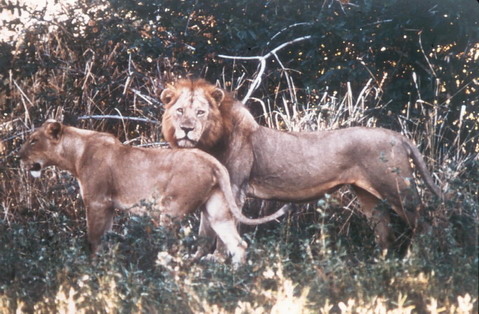
The park is noted for its massive herds of buffalo, a spectacular sight if they’re seen on the run, kicking up dust for miles behind them. Large prides of lion inhabit the territory and it is not uncommon to witness a kill. Other common mammals are hyaena, Cookson’s wildebeest, bushbuck, zebra, warthog, baboon, vervet monkey, puku and impala. Elephant and leopard are also seen, but not as frequently as in the South Park. You are more likely to see hartebeest, reedbuck and eland here, however. All the birds in the South have been recorded here as well. Sighted regularly are the crowned cranes, purple crested loeries, broad billed roller, Lilian’s lovebird, the carmine bee-eater, giant eagle owl and Pel’s fishing owl. Occasionally seen are the bathawk, black coucal and osprey.
Getting There
Although this park was officially opened to the public in 1984, the infrastructure in and to the park is not sufficiently developed to cater for the independent traveller. Special permission to enter it must be obtained from the Dept of National Parks and Wildlife Services in Chilanga or Mpika. This is not advisable due to its remoteness should anything go wrong with your vehicle. The best way to experience this park is with one of the operators running safaris here. One can fly in to either Mfuwe International Airport, about four hours away and be picked up, or be brought in from the Mpika side of the escarpment. There are two airstrips that are open for charter traffic.
Where to stay
There are no lodges open to the public in the North Park but several operators run prebooked, organised safaris there.
Shiwa Safaris have two bush camps and their safaris begin at the Shiwa Ngandu estate over the western side of the escarpment.
Zambia's smallest owner-operated camp, Kutandala Camp catering for only six guests on each safari. All the rooms have an unrestricted view of the Mwaleshi River and its flood plain throughout the day.
Mwaleshi Camp situated on a scenic bend of the Mwaleshi River, a beautiful river within the North Luangwa National Park. It comprises of 3 attractive reed chalets, each with stunning views over the river. Game viewing is on foot, in a remote area renowned for its lion, huge herds of buffalo and endemic Cookson’s wildebeest.
When to go
Operators in this region conduct safaris in the dry season from June to October when animal sightings are at their peak. Access in the wet season is virtually impossible.
http://www.zambiatourism.com/travel/nationalparks/nluangwa.htm
Subscribe to:
Posts (Atom)