Tuesday, April 23, 2013
Norman Carr’s Chinzombo Camp in the Luangwa Valley
Friday, November 16, 2012
Norwegian government injects over K200 billion in South Luangwa
Wednesday, September 5, 2012
Norman Carr Safaris to Open Luxury Lodge in Zambia’s Luangwa
Carr said that Chinzombo represents “another step in the evolution of the Rech and Carsten luxury bush camp design philosophy,” with modernist architectural forms combined with organic geometry, regional materials and indigenous Zambian building methods. The property is being built where Norman Carr stayed during Luangwa’s Emerald Season,
Chinzombo will have six villas, one that can accommodate a family of five or more. Villas are Wi-Fi-equipped. The villas stand under shade trees on a ridge over a loop in the Luangwa River. The villas have large, air-conditioned bedrooms, luxurious bathrooms and private plunge pools on shady decks overlooking the Luangwa River. Materials are natural, and includes locally produced leather, reed-work and canvas. Floors are made of recycled composite timber. There is no concrete or brick. Décor utilizes raw linen, timber, copper and hand-made crockery. The property will open for business March 1, 2013.
Original article here
Norman Carr Safaris
Friday, January 22, 2010
African Safari Tour
An African safari is an exciting vacation far from the cares of everyday life or a person's typical environment.
On a safari, individuals can observe wildlife, take breathtaking photographs, and experience some of the most beautiful places on earth.
Many people believe that safaris are dangerous because the wildlife is really wild and is roaming free in the environment, but the truth is that numerous safety precautions are taken by the guide of the African safari to ensure the safety of every person on the tour.
An African safari vacation is a great idea for people of all ages. The tours combine all of the excitement and adventure of a safari into a smaller amount of time.
The guests do not have to stay out in the wild overnight unless they choose an overnight safari.
African safaris are great for viewing wildlife in their natural habitat and seeing how they truly act in nature. The intention of the safari guide is to ensure that individuals have a great time and get to see as many animals as possible.
African Safari Specifics
The length of an African safari will vary from company to company. Some safaris last for a few hours while others can last for a few days.
Read More
Wednesday, October 14, 2009
Top 10 safari destinations in Africa
One of the main reasons most travelers choose to visit Africa is her wildlife parks and conservancies. These are certainly the highlight of any African trip, and here is the BootsnAll top ten choice of African wildlife destinations.
10 - Mana Pools Zimbabwe: These days Mana Pools is a little bit of a forgotten backwater on the African eco-travel map. The recent history of Zimbabwe has tended to isolate it from the mainstream which has done very little to help the conservation effort.
Mana is unique because it is different. The park is situated on 2500 square kilometers on the south bank of the Zambezi River. The area is a mix of riverine habitat rich in crocodile and hippo, floodplains supporting large herds of herbivores and a back-country of low lying Mopane woodland interspersed with thousands of mature baobabs.
The diversity of wildlife and scenic interest is just one of the reasons why Mana Pools should be a tick on your map of southern African eco destinations.
9 – Gorongosa Mozambique: This park, situated in north central Mozambique, is one of the region’s oldest and most troubled conservancies. Once the jewel of the colonial Portuguese conservation effort, and denuded almost to extinction during Mozambique’s series of civil wars, it is now one of the most visitable parks in the region.
Also of mixed habitat, the vortex of the park is a wet depression that supports a rich variety of vegetation that in turn provides succor and habitat to a huge diversity of wildlife. To the west lies Mount Gorongosa with its large number of endemics and unusual forest habitat. To the east wooded Miombo hill country offers shaded sanctuary to the more elusive of the African plains species.
Slowly being restocked, Gorongosa is still a work in progress, but is the focus of much international money and interest, and for the moment seems to have an assured future.
8 - South Luangwa Zambia: One of the principal watersheds of this large southern African nation is the Luangwa River which runs north to south along the east of the country, flowing ultimately into the great Zambezi. A significant section of the river frontage is reserved under the protection of two national parks. The North and South Luangwa National Parks are allied but different, and of the two it is South Luangwa that is the more popular.
Covering an area of 4636 square kilometers of the river’s east bank, South Luangwa offers a mix of riverine and floodplain habitat with high cliffs and forested hilltops. The park supports excellent wildlife diversity and offers the option of walking safaris.
This park is fairly new to the circuit, but is easily accessible, well maintained and protected, and served with excellent lodge and camp hospitality options.
7-Kruger National Park South Africa: This is one of Africa’s flagship wildlife destinations and one that sets the bar extremely high in the matter of wildlife conservation, breeding, research and study. As a consequence it can seem a little overdeveloped although the up-side is that all you ever hoped to see of African wildlife and more will be found here.
Kruger is an authentic bushveld destination with wooded savanna and acacia thornveld being the predominant habitats. This is also quintessential big game country where you can be justly disappointed if you do not regularly bump into the Big Five.
Easily accessible, well funded and managed, and exceptionally well and efficiently served with all the necessary amenities. This is a great option for beginners. It is civilized bundu-bashing in a developed-world atmosphere.
6 - Khalaghadi TransFrontier Conservation Area South Africa: This is another of South Africa’s superbly run national parks. Linked under international treaty (the Peace Parks Foundation) with Botswana, the combination of two enormous wilderness preserves in the Central Kalahari has opened up a vast an uninhibited safari area for those equipped for rough travel.
The better traveled region of the park is easily accessible and in a desert and semi-desert environment some of the signature scenery of Africa can be enjoyed from the deck of a luxury camp or lodge. Penetrate deeper into the wilderness and you can park your Landrover under a baobab and neither see or hear another human being for weeks.
A great option for enthusiasts, second timers and expedition junkies. Expect to see the Big Five with many other more localized or endemic species.
5 - Masai Mara Kenya: This is the sister park to the iconic Serengeti National Park and is a continuation of the same broad eco-zone. The annual migration of antelope species in astonishing numbers that define the region usually begins and ends in the Masai Mara. This is one of Kenya’s signature wildlife destinations so it is both heavily visited and carefully controlled.
However the inevitable jostle at certain times of the years is compensated for by one of Africa’s most Eden-like landscapes replete with natural splendor. Masai Mara is large – some 25 000 square kilometers - and is composed mostly of open grasslands and plains. The justly famous East African hospitality industry reaches its zenith in places like the Masai Mara so expect some of the highest standards of luxury on the planet.
This is an all-comers national park with something for everyone. The Big Five are dominated here by lion and cheetah but you can hardly fail to run into the rest too. Altogether an accessible, well managed and protected national park with some of the best photographic potential in Africa.
4 - Etosha Pan Namibia: Namibia is one of the most celebrated safari destinations in Africa. With a sparse population and all the wide open spaces a body can absorb, this is wild Africa with a very civilized underbelly. Etosha Pan is in a dry and unforgiving corner of the continent but despite that it is one of the most rewarding of the regional eco-destinations to visit.
Well managed, isolated and well protected this expanse of bushveld surrounding a seldom flooded pan enjoys unique ecological perspectives as well as all the best of African game safaris. The Namibians are excellent at long range 4×4 adventure, so for a little outlay an authentic African safari adventure is there for the taking.
Very wild and very real, this park is nonetheless easy to get to, easy to see and comfortable in the grand colonial tradition. Practical for all budgets. You can get the best and the most basic here.
3 - W National Park Niger: This park scores the highest points in Africa for interest. Very few eco-travelers ambulating the continent with binoculars in hand ever give much thought to West Africa. This is thanks mainly to the popular perception of teeming populations and very limited surviving natural heritage. Across most of the region this is true, but at the thee corners of Niger, Benin and Burkina Faso a unique configuration of river and land has been preserved as the W-National Park, a responsibility nominally shared between these three countries.
This regional conservancy covers some 10 000 square kilometers of largely uninhabited territory dominated by the delta of the Mekrou River with the Niger River. It is broken by rocky hills and expanses of bushveld. Equally unexpected wildlife encounters are frequent here with one of the last surviving populations of West African elephant and rare West African giraffe. Also expect to see cheetah, Lion and leopard with possible sighting of African painted wild-dog. Besides this there are many antelope species. W-National Park is a sought after birding destination.
So all in all an unusual eco-travel option with a frontier feel since facilities are scarce and access tricky. It is worth the effort though as Africa’s number 3 option.
2 - Okavango Delta Botswana: This is the Eden of the south. One of very few international inland deltas, the Okavango is a product of the Okavango River finding no outlet to the sea but instead spilling into the Kalahari desert and creating a vast and spectacular oasis that is home to some of Africa’s most unusual and prolific wildlife destinations.
The Delta is not wholly protected and is technically an area of mixed usage. Human habitation is present but limited, and on the whole the region is given over to wildlife. The main area of national park is Moremi Game Reserve which links in the north with Chobe National Park. Both are among the most important eco-destinations in the region.
Both parks have a riverine/riparian aspect with access by dugout and other river-craft. With generally superb standards of game management throughout Botswana you can expect to see the best of the Big Five and much more besides.
1 - Northern Circuit Tanzania: This is not one destination but several. The Tanzanian Northern Circuit revolves around the iconic Serengeti National Park, but it also includes the equally iconic Ngorongoro Crater Reserve and a handful of smaller destinations including Tarangire National Park, Lake Manyara National Park, Lake Eyasi, Arusha National Park and of course who could forget Kilimanjaro National Park.
The usual way to get the best of the Northern Circuit is a climb/safari packages that taxes your physical endurance and then soothes it with a relaxing safari among some of the greatest natural treasures in the world, and among some of the most esteemed representatives of the global hospitality industry.
In every respect the eco-travel potential in this region is superb. Although budget travel is not really encouraged, it is possible, but it is only when you dig deep in your pocket and spoil yourself with luxury that you will get the best that this region has to offer.
Features include the annual migration that takes place between the Masai Mara and the Serengeti every year. If you are lucky enough to catch this you will have witnessed one of the world’s greatest natural phenomenon.
http://www.adventurelogue.com/travelnews/top-10-safari-trips-destinations-in-africa.html
Saturday, September 19, 2009
Zambia safaris: Elephants, baboons and a walk on the wild side in stunning South Luangwa
A gentle voice outside the tent-flap murmurs: 'Morning, morning.' During the night, hyenas whooped and howled persistently, so close behind the camp that their mournful wails seemed to rattle the guy ropes and, from time to time, lions roared. But now, just before dawn, absolute silence reigns.
Trunk enthrall: Elephants and buffalo cross the Luangwa River in Zambia
Hot water has arrived in each washing bowl. Breakfast is ready on the riverbank: tea, coffee, porridge and toast, cooked over a fire of mopane wood, which gives the food a special tang. We eat quickly, on our feet, watching the eastern sky start to glow, until a huge ball of fiery crimson climbs over the horizon and sets the surface of the river alight.
By 6.15am we are on our way. 'Keep behind me in single file,' says our leader, Robin Pope. 'If anything starts to happen, stay bunched together. Don't run.'
Out front is our escort scout, Piela Nandila, armed with a loaded .375 rifle. Next comes Robin, then the six of us, and at the back our tea-carrier Jonathan Mbao, swinging a fearsome machete.
Read more: http://www.dailymail.co.uk/travel/article-1213066/Zambia-safaris-Elephants-baboons-walk-wild-stunning-South-Luangwa.html#ixzz0RbsQTEQd
Saturday, August 22, 2009
African Safari Destination – The Luangwa Valley, Zambia
The river is so natural that oxbow lakes are scattered across the valley from where the river course has changed with the floods. Over the years river side camps and lodges have had to move. Here the river is king!
It is said that the Luangwa River in Zambia is the most unaltered and significant river system in Africa and it certainly is the key ingredient that keeps all 9050km2 of the park with over 60 different animal species and over 400 different bird species alive.
A large quantity of game can be found here since Zambia remains largely untouched by the tourist rush. Water results in rich vegetation that feeds varying herbivore animals and herds including buffalo, elephant, puku, impala and the more rare subspecies of Thornicroft giraffe and Crawshay’s zebra that are found here. Healthy and large populations of herbivores feed predators like lion, hyenas and leopard. In fact a BBC documentary suggests an average density of one leopard per 2.5km2 – twice the density recorded in Kruger, South Africa.
The best time to see game is in the dry season from April to October. As the river dries up the animals visit the lagoons and oxbow lakes to drink more frequently. Seeing them here in their natural environment is breathtaking.
As short rain showers begin to fall in November most animals give birth to their young and since the grass is still short spectacular sightings of mothers and their young can be seen. The landscape begins to change from a golden brown, dusty and dry land to an emerald green – known as Zambia’s green season.
Zambia’s Luangwa River also means that the valley can boast very rich populations of tropical bird life, including birds that live close to water and birds that prefer drier habitats in the forests and on the plains. The best time to see these birds is in the rainy season (November to March) since the rain provides abundant food supplies for them. Summer migrants are also present in the Luangwa valley at this time. Flocks of birds can be noted and a special site is a breeding colony of yellow-billed storks with their pink breeding plumage. The rain does not fall consistently and rarely lasts for more than a few hours, so you can still enjoy game drives and birding to the full.
In April and May, the rains will have stopped and the landscape begins to dry out. The Luangwa rivers water level begins to drop and sandbanks (the signature of the Luangwa River) are exposed. Once drenched roads begin to dry out and the main safari season beings once more. As the lush green grass begins to turn golden brown one truly understands the Luangwa River really is the life blood of this untouched landscape in the Luangwa National Park, Zambia.
Note: If you wish to publish this article on your website, blog, etc. you can as long as the article remains in its full entirety; including the links and the author resource box.
Sara Brown is instrumental in the running of the Best of Zambia site (http://www.thebestofzambia.com/), a website dedicated to putting Zambia on the map by creating a strong internet presence and successfully promoting Zambia and those operating in Zambia. This site will help potential visitors to Zambia reasearch this beautiful country, find the perfect holiday in Zambia, plan their trip and send out enquiries. As the site develops it will have useful links to the international development sector, commercial and investment opportunities and, local businesses and services.
Our mission is to ensure the Best of Zambia site becomes THE information hub for all things Zambia. You can learn more about the Best of Zambia and how you can benefit from our products and services at our constantly updated website, http://www.thebestofzambia.com/
Zambia is stunning and tourism is increasing. Despite this many would prefer Zambia to stay exactly as it is – a place that is fascinating, a rich resource of natural habitat and animals that few other people visit. As we promote Zambia, we ask that you respect its resources and people and help to preserve it – be a thoughtful visitor.
Article Source: http://EzineArticles.com/?expert=Sara_Brown
Monday, July 6, 2009
KIDS FOR FREE WITH NORMAN CARR SAFARIS
Only flights and National Park fees to pay.
Offer applies from July 1st to October 31st 2009.
No minimum stay, applies to children up to the age of 17.
Children will stay in the same room as full paying adults. All accommodation, meals, drinks and game viewing activities are free of charge for each child traveling with full paying adult. Offer applies to Kapani Lodge but if availability and child’s age allows – bush camps may be included in the safari.
Contact
Kapani@normancarrsafaris.com
for a quote and further details
Friday, July 3, 2009
What Makes A Safari in Zambia Unique?
Zambia is located in south central Africa with eight neighboring countries. There are 19 national parks and 34 game management areas. Thus a whopping 30 percent of the country’s 752,614 sq kms. The country has the largest water resources in southern Africa. There are large empty tracts of land in pristine state and a large wildlife estate. Zambia’s unique natural resources include minerals such as copper, precious stones and lumber; both native hard wood and soft exotic pinewood timber.
The population to land ratio is one of the lowest in Africa. At less than 15 people per sq km it is one of the lowest in the world. The sparse population has left a large portion of Zambia unspoiled in its natural state. You get to see teeming wildlife in pristine wilderness. Some of the animals have had little or no contact with humans. So the national parks present wildlife in its natural habitat.
The National Parks
Of the 19 national parks South Luangwa is Zambia’s premier game reserve. The South Luangwa National Park has probably the largest variety and concentration of game in Africa and perhaps in the world. Experts consider the 9,990 sq kms park to have some of the finest game-viewing areas anywhere. It is rated one of the top game reserves in the world with a profusion of wildlife. Some animals are only found in this reserve. An example is the Thornicroft giraffe.
Another game reserve is the Kafue National Park. The sprawling 22,400 sq kms is the second largest national park in the world and is about the size of Wales in Britain and twice the size of Yellowstone National Park in the USA. The park is located in the central-western Zambia and boasts excellent game viewing, bird watching and fishing.
The park has two unique wetlands. The Busanga Floodplain in the northern sector is special. The emerald green Lunga, Lufupa and Kafue Rivers crisscross it. Here are found multiple species of animals and birds. The Busanga plain is antelope country. The endemic lechwe fill its plains. The park’s southern limit also breaks into another wetland the Nanzhila Plains. The plains are next to Zambia’s newest lake at the Itezhi-Tezhi Dam.
http://www.fundednfree.com/africansafari.html
Thursday, March 26, 2009
Luangwa Valley
"There is a huge wild valley in Zambia called the Luangwa Valley that just cannot be tamed. Of course, people have lived there since time immemorial, but they were unable to modify their world to any significant degree because the environment was just too tough for them.
In the 1790s chief Kazembe of the Lunda encouraged the first Europeans, the Portuguese, to open trade routes from Tete into Luangwa. The Portuguese found the place to be inhospitable and dangerous. They were plagued by malaria and troubled by wild animals.
In time, however, the Portuguese government granted estates throughout the Luangwa Valley, called Prazos, to families of mostly mixed Goan and African parentage. The Prazo owners formed their own bands of mercenaries and fought each other in this wild, lawless country. The ‘armies’ became known as the Chikunda, which is what the current inhabitants of the Luangwa Valley are often known as. By the 1890s Jose d’Araujo Lobo was the most powerful Prazo owner with an army of 12,000 men.
The strongest challenge to the Portuguese came from the Ngoni, an offshoot of the Zulu nation who were moving up from the south. The Arab traders from the coast also challenged them. But the British were the ones who finally forced the Portuguese to leave the valley, chased out the Arabs, and conquered the Ngoni.
What is particularly interesting about this rich history is that today one sees very little physical evidence of the Luangwa Valley’s past.
It has all been eaten by termites.
And things have not changed very much. We all built houses there, and lodges, and camps, and every so often the Valley (as it is affectionately known) reminds us that it is its own master. Every rainy season in fact.
I have never seen such active termites as in the Luangwa Valley. During the rains it seems that they go onto steroids and quite literally eat everything. We used to walk up to the bar at the nearby lodge in the evenings, and by the time we returned home the termites would have built a series of small towers coming up out of all the small cracks in the concrete floors. These humble beginnings of termite mounds could be four inches high when we caught them by surprise building away in our lounge. A colleague living nearby had a large personal library and kept each book in its own separate ziplock bag in order to keep them away from the busy jaws of the termites. They ate the back wall of our house and the thatch roof.
Snakes also come out aplenty during the rains. Big ones, small ones, medium-sized ones, up to five of them a day around the house and lodge. We had one particularly large cobra that seemed to live in a huge termite mound outside our house. Several evenings while we were drinking at the bar, our night watchman would come running up to tell us that this large snake was in the house and wreaking havoc. The snake was able to enter through the poorly crafted thatch roof, which was not good when our children were all tucked up sleeping in their beds. We would go down and usually find nothing. On one occasion, though, we found all the bottles on the bathroom shelf knocked to the ground. Then one day I found him in the roof of the outside long-drop and shot him from the inside with a 12-bore shotgun. It wasn’t very good for the roof.
Everyone tried to stay open year round and struggled through each rainy season with a dribble of wet tourists. Some new operators arrived, and one actually said to me in the bar late one night, “I’m going to show you guys how to run a proper safari business here.”
He sold his camp a couple of years later to an unsuspecting romantic.
There are a very small handful of safari operators and professional hunters who have lived in this valley for a long time. Adrian Carr is one of those people. Some readers might know Adrian due to a well-published, but unfortunate, accident with a fine Rigby rifle back in the 1970s. But that story has been documented elsewhere.
We had our small ramshackle collection of huts about 200 yards from Adrian’s house, and I apprenticed under him when I was doing my PH licence. So we got to spend a lot of time together in the bush.
We had a frightening encounter with a snake some years back. A buffalo had been wounded and we were following it. We spooked it twice, and each time we became a little more tense. Finally it entered the thicket along a dry, sand river. In we went and soon realized that its tracks were meandering back and forth and crossing themselves. We became even more tense. Eventually we found ourselves in a large stand of tall hyphereania. The two trackers were ahead of us and bent double, faces almost to the ground following the tiny drops of blood. We were behind, peering for all we were worth into the thick bush for any sign of the buffalo. Safety catches were probably off and fingers were probably curling ever so lightly around triggers. The buffalo just had to be close.
And then the two trackers turned into something molten and flowed back past us with such speed that we were slightly distracted by the sheer grace of it. My first conscious thought was, “OK, here it comes.” But there was no noise. No crashing of undergrowth and no heavy thumping of hooves.
And then Adrian leapt back, one nanosecond behind the trackers. That left me … brave … to face the music, and thinking, “That’s unlike Adrian.” And then I leapt back another nanosecond behind Adrian. And in that instant of us all leaping back we saw in front of us a spectre from every universal nightmare from every age of horror.
A seven-foot-long, two-headed puff adder was striking at us with both its hideous mouths agape and all four hideous fangs dripping with yellow venom. After leaping we staggered backwards, tripping over each other and stumbling to a rest several yards back. The buffalo was forgotten.
It took some time and a lot of confused chattering between all four of us:
“Huge snake!”
“Two heads!”
“Striking!”
“Both heads!”
“Let’s have a cigarette.”
But finally we went back to see the two-headed beast. By now, being a snake, and not very smart, it had settled down to doing what it had been doing before we had stalked so quietly onto it.
There, in an excited state of sexual bliss, and still joined at the vent, were two extremely large mating puff adders. With a long stick we hooked one up and it came with its partner attached. Inseparable they were.
But back to the story at hand.
Everyone with any sense knew that sooner or later the Luangwa River would flood properly. But we all built camps on the river. Of course!
Then in the rains of 2007 the river came up. Then it came up some more. “Oh it’s not too bad,” everyone said, “It’s good to have a proper rainy season for a change. This is just how the river should look at this time of year.”
And then overnight it rose even higher, and all the camps along the river were flooded. Water came up high enough that it flowed through windows and into well-decorated chalets. The lodges were all abandoned while everyone waited for the water to drop. And while everyone felt sorry for the lodge owners who lost a lot, it was really the local villagers who lost everything. These descendents of the Chikunda fighters had houses built of mud mostly along the banks of the Luangwa River’s tributaries. They all disappeared and people were left, standing on the edge of the one raised road that runs to the airport, with pathetic collections of what they had managed to salvage.
After a time the water started to go down, and the safari operators slowly started to move cautiously back in. The buildings were all awash with mud and slush. Adrian came back early and waded through what was normally dry land but was now a flooding Luangwa River, to get to his house that was on a slightly raised piece of land and thus almost dry. The water had receded enough to be lapping at the kitchen step.
Adrian and his partner Christina waded through flowing floodwater to their house and climbed the back step to survey the disaster. The inside of the house was, of course, a muddy mess, as they sloshed disconsolately from one room to the next. And in the main bedroom they found a large, black-necked spitting cobra.
One has to have seen a big black-necked spitting cobra to really know what a powerful presence it has. They are often over six-feet-long, and jet black. So jet black that they shine the deepest blue in sunlight. The scales seem as large as bathroom tiles, and they can be as thick as your wrist. And then they always turn to look at you when you approach. This is the most disconcerting. When a snake turns its head to watch you and fixes those dark eyes on you, you stop to think. The head is thick, rounded, blunt, muscular and … scary. The venom is a powerful cocktail of cytotoxins and neurotoxins and, of course, it not only bites but will also spit this venom into your eyes. I would think that after the black mamba it must be the most awe-inspiring African snake. So, of course, everyone is scared of them.
It is easy to imagine then, the fright they must have got when they walked into their bedroom and encountered the cobra. Adrian had a .22 rifle with him, and so he shot the snake. Then he shot it again, as you do with a large cobra in your bedroom. Then he carried the corpse through the muddy house draped over a muddy broom and left it on the kitchen step. He and Christina continued their house survey.
A few minutes later they returned and the snake had gone. They still had to wade back through the water where the snake had disappeared, so Adrian decided he had to find it. So he stood on the kitchen step, leaning out and hooking into the muddy water with the broom. About three metres away a single black coil of cobra rose slowly out of the water and disappeared in a gentle swirl as the current took it further away.
In every situation like this, there is a moment at which one could have backed off and saved oneself a useful place in the theory which Darwin propounds. But all too often we show that, indeed, we could easily be removed from the gene pool with no detrimental effect to the human race.
So into the water Adrian went to go and hook the snake and remove it from where he and Christina had to wade. And then a little deeper, above the knees fishing with the broom until, “Bugger me if I don’t feel it coiling around my leg … a couple of full, tight coils. So, like a Dinka warrior I lift my leg … slowly … stork-like from the water … and all six feet of shiny black snake is around my leg.” And if that wasn’t bad enough to send one to never-ending therapy, he continues: “The mouth is partially open, right up against my calf.”
Adrian had visions of dying cobras that we have seen bite pieces of wood or even themselves, but he somehow managed “to reach down ever so slowly and grab it just behind the head, all the while expecting a full bite.”
And his story ends thus “… I was shaking like a leaf. We then had a nice cup of tea (with lots of rum).”
http://russelhunter.wordpress.com/2009/03/26/puff-adders-cobras-and-floodwaters/
Wednesday, March 25, 2009
World Big Cat Safaris
World Primate Safaris is a very successful specialist tour operator that sends people out ot Africa and Asia to track some of the most endangered primates in the world, and at the end of 2008 their sister company World Big Cat Safaris was launched.
Again, World Big Cat Safaris relies on their expert knowledge of the areas they specialise in to
make themselves different to everyone else. The 3 tour consultants in the office are ex tour leaders and guides from the various regions of Africa and so their first hand knowledge is second to none.
World Big Cat Safaris are specialists safaris to track the Big Cats of the world. They tailor adventure or luxury safaris with a selection of mobile camps and luxury lodges in some of the best wildlife areas in the world...Safari Holidays are our speciality whether it be a tiger safari in India or an African Safari to Botswana.
World Big Cat Safaris donates a percentage of each safari sold towards the conservation of endangered Big Cats throughout the world. Holidays can be tailored to meet each specific clients requirements including luxury honeymoon safaris, family African Safaris, walking safaris and much, much, more.
World Big Cat Safaris offers a selection of traditional Kenya Safari Holidays to see the savannah game of the Masai Mara. Kenya is at the forefront of wildlife conservation and community led initiatives and is perfect for a honeymoon safari or family safari and beach relaxation.
Tanzania is a prime wildlife safari destination. Your Tanzania Safari can combine the wonderful Serengeti National Park, the stunning Ngorongoro Crater and the pristine tropical islands of Zanzibar or Pemba. Your Tanzania Safari should make the most of the fantatsic selection of luxury lodges and camps that are now available throughout Tanzania.
Wildlife in Botswana is the highlight. The Okavango Delta and Chobe National Park provide the ultimate locations for your Botswana Safari. An expensive safari destination, Botswana provides luxury safari accommodation with unique access to private concessions providing the ultimate in wildlife safari viewing.
Your South African Safari can consist of a multitude of interesting activities including a wildlife safari in the Kruger National Park or its surrounding private concessions, the winelands of the Cape and some of the most scenic coastal drives in the world. A luxury South African safari is actually very good value for money in comparison to other African Safari destinations.
Zambia Safaris are up and coming as Zambia is new as an African Safari destination. Your Zambia Safari will concentrate primarily on a few areas, including South Luangwa Valley, Lower Zambezi, Kafue National Park and the renowned Victoria Falls. Walking Safaris are also a highlight with some of the best African Safari guides available on the continent.
A Tiger Safari in India is the highlight of any wildlife enthusiast’s career. A typical India safari may consist of the one horned rhinos of Kaziranga, the Asiatic Lions of Sasan Gir National Park and of course the endangered but majestic Bengal Tigers. The best places to visit for your India Tiger Safari include the historic Corbett National Park, Ranthambhore, Bandhavgarh and the tiger park of Kanha.
The large predators are what people want to see when they go on a safari and with World Big Cat safaris they will put you in the best place to maximize your chances of seeing them.
http://www.pr-inside.com/world-big-cat-safaris-which-is-r1137746.htm
Monday, January 5, 2009
Safari in Zambia
Safari here is unusually outdoorsy and involving, often including a high quotient of walking. Real safari for real safari people.
The primary area is the wonderful South Luangwa and the more remote North Luangwa. To the west is Kafue, a huge and remote wilderness, whilst to the south Lower Zambezi is a superb location for canoe safari in particular. Not to forget the Victoria Falls at Livingstone.
Take a look at our list of the best lodges in the country.
http://www.africatravelresource.com/T1/africa/zambia/0/intro/?gclid=CIiYtu6T-ZcCFQFvGgod6hQbDg
Saturday, April 26, 2008
Zambia: Born to be wild (+photos)
So kids," I say, dragging out a kindly voice from my schoolteaching days and turning to the children seated behind me in the four-wheel drive, "which animal do you most want to see on safari?"
We're about to leave Lilongwe, the capital of Malawi, and head across the Zambian border for a five-day safari in remote South Luangwa National Park, and have just met the British family of five who will be our companions on the trip. Rosie, 10, answers first: "Elephants and hippos and zebras and giraffes."
At 12, Josh is more decisive. "Wild dogs," he says, choosing one of the rarest, most elusive carnivores in all Africa.
Sam, who is 8, has his nose buried in the latest Harry Potter book. His head is too full of hocus-pocus at Hogwarts to give a definitive answer, but the African wilderness is about to create its own magic - for all of us.
Our cheerful guide Ben, from Land and Lake Safaris swings up into the big Land Cruiser and we're soon chewing up the kilometres towards the border. Once in Zambia, the going is slow, hot and dusty as we negotiate 100km of rough dirt road, passing through forests and scattered villages of thatched huts where villagers stop to watch the unfamiliar vehicle bounce by. It's fascinating, but everyone sighs with relief when Ben says we're nearing our lodge.
Rosie gets one of her wishes before we even arrive when we jolt around the final corner to find the track blocked by a herd of elephants.
The rigours of the drive melt away as we sit in awe, watching them use their dextrous trunks to tear at trackside trees before they amble off into the bush.
On arrival at the lodge, strange noises draw us to a bank overlooking the Luangwa River. Several large crocodiles bask on a sandbar in the middle. Just below us the nostrils, eyes and ears of a dozen hippos are visible above the murky water. Every so often a hippo surfaces, opening its cavernous mouth to let out a mournful bellow, a sound that becomes synonymous with our stay.
South Luangwa covers 9050sq km, with the twisting course of the Luangwa River at its heart. This seldom-visited park has one of Africa's highest concentrations of game, so with that in mind we retire early to get a decent sleep before our first game drive. The hippos and the trill of myriad insects and frogs disturb our slumber, as do elephants cavorting in the overflow from the nearby water tank and ripping at low trees right outside our window.
Still, lack of sleep doesn't dull our anticipation and we set off at sunrise, wrapped up well against the chilly African morning.
Just over the bridge into the park our safari guide, Flemings, opts to take one of the smaller trails.
We've been on it only two minutes when someone whispers loudly, "Wild dogs".
Everyone looks sceptical, but Flemings obligingly reverses our customised open-top vehicle and noses off the track, crunching through the thick undergrowth. Sure enough, there in a clearing, six wild dogs are devouring an impala they've just killed, their white-tipped tails wagging furiously and their mottled coats stained with blood.
The dogs, also known as Cape hunting dogs or painted wolves, aren't going to give up their kill because of us so we're able to edge in close.
In the tall, tawny grass we spy a spotted hyena greedily eyeing the dogs' meal. He tries to slink in beside them but is smartly chased away, with a sharp nip thrown in for good measure. Soon the dogs have had their fill and lope away, bloodied tongues lolling as they run. Immediately, the hyena moves in, making short work of the carcass as his powerful jaws crunch through bones and skull.
So Josh gets his wish with the unexpected sight of the endangered dogs and a scavenging hyena.
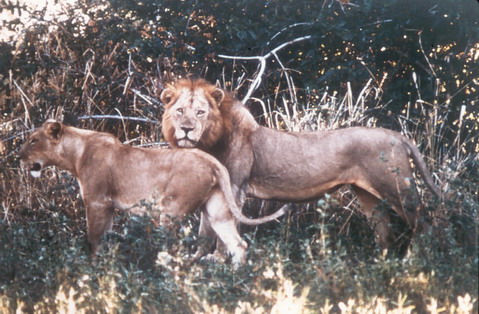
It will remain a highlight, but there are many more to come. During our stay we have three lion encounters, one of which involves a lonely lioness stalking a handsome male and another female. While we're engrossed watching the pair in front she sneaks alongside us, using the vehicle as a shield.
The British children's mother, Louise, gasps as the lioness passes within centimetres of Rosie, who has opted to sit in the door-less passenger seat.
But the lioness moves on to confront the other lions. The angry male snarls and lunges, chasing her behind a tree where she curls up sadly like a rejected kitten. The last we see of them, the single lioness is watching forlornly from a rock as the pair saunter away across a dry watercourse.
Later we come across a herd of about 600 Cape buffalo and, when we stop near a waterhole for morning tea, a dozen zebra step down to drink - nervously watching us as well as the hippos and crocs. Giraffes, elephants, zebra and warthogs regularly cross our path and impala become so commonplace that we barely notice them.
We do notice the incredible variety of birds and with Flemings' help we are soon able to identify gorgeous lovebirds, weird ground hornbills, various water birds, kingfishers and birds of prey.
South Luangwa has a good population of leopards and during night safaris we hope that the powerful spotlight will pick up one of the big cats. It doesn't, but we see other nocturnal creatures, including genets and civets, mongooses, hares, hyenas, and hippos that have come out of the water to graze.
Our final great experience comes at the last sunset of the trip when we stop to watch the blazing red ball sink below the forest.
In the river behind us hippos moan and groan, while in front of us three enormous elephants materialise out of the trees and stroll across the open ground. All of our safari wishes have come true.
http://www.nzherald.co.nz/section/7/story.cfm?c_id=7&objectid=10505200
Friday, February 29, 2008
Obscure joys of a blue square
Time to celebrate my contribution to science. The long-awaited work The Birds of Zambia is with us after all but 40 years in the making, and it is a triumph. What's more, I am part of it. You can find me in the acknowledgements: “Many friends and colleagues have added to knowledge ... too numerous to name all here.” That's me. Too numerous to name, but there.
Take page 382. The meat of this book is in 750 maps of Zambia, each one representing the distribution of a species of bird. The entry for cloud cisticola includes a map with a light sprinkling of small blue squares. Each blue square represents a place where the cloud cisticola has been recorded. One square is hundreds of miles from the rest. Rum, eh? The squares are 30 by 30 nautical miles. There are seven blue squares for cloud cisticola on the Angola border: the rogue square covers a tributary to the Zambezi much farther south. The text points this out and adds that the observation was made by Stjernstedt in 2003.
What it doesn't say is that I bought Stjernstedt's petrol, in circumstances it would be indiscreet to reveal. It doesn't say that I bought the J&B whisky; it doesn't say that I bought the Mosi (the local beer). It doesn't say that I was there, giving the aforementioned Stjernstedt the benefit of my knowledge, experience, culinary skills and beer.
This was a demented expedition in which we got triumphantly lost, survived my campfire cooking, drank the whisky in the clamminess of the night and still made the plane home. Baron Robert Stjernstedt, for it was he, is an old friend, a proper ornithologist and genius at song and call. He also runs a business called Birding With Bob.
Background
He picked out the amazingly unexpected call of the cloud cisticola, singing from a cloud just as it should, rather in the manner of a skylark. We recorded its voice and after some hours we got a clear view for a field description. We drove on, camped, sipped, having pushed back the frontiers of human knowledge by a full micron.
There are other birds in this book that I can boast about. Bob and I made another expedition, this time to North-Western Province. We made 39 new records on that trip, including the gorgeous Narina's trogon, named by the 18th-century naturalist François Le Vaillant for his lovely Khoi Khoi mistress.
I, and I alone, can claim our record for African broadbill. I heard its whirring wing-flicking noise when I was lying in a tent feeling like death; as expedition cook I had inhaled too much camping gas, largely because Bob had neglected to pack a shifting spanner. I recall the beauty of the rosy-breasted long-claw, the gorgeous song of Bocage's robin, the mundanity of tree pipit, the subtlety of Laura's warbler, for which Bob's lovely daughter is named.
I have made other atlas records with Bob in other places across Zambia, memorably at the time we drove up - just - the escarpment of the Luangwa Valley. We celebrated by drinking Mosi at a temperature at which it is perfectly acceptable to serve coffee.
This book contains years of work by great and dedicated observers, and it is a joy and privilege to be associated, even in so tiny a way, with so fine a venture. The glory of being too numerous to mention will be for ever mine: along with the memory of sodden singing, wringing wet forest mornings and fire-lit, whisky-lit forest evenings.
http://www.timesonline.co.uk/tol/comment/columnists/simon_barnes/article3463387.ece