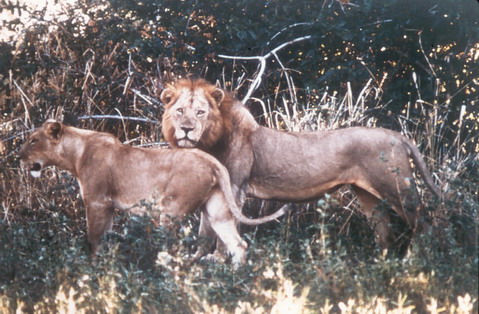
Norman Carr pioneered walking safaris back in the 1950’s and the Luangwa Valley today is still one of the best places to explore on foot. Game drives are also on offer but as Norman always maintained, to view the bush from a vehicle is simply to be an observer, but to get out on foot was to become a part of your surroundings. To stand in silence and see the flick of a lion's tail as he disappears into the bush acutely aware of your presence as another apex predator is infinitely more exciting than sitting in a jeep somehow apart from the real wilderness.
The Luangwa Valley is the home of the walking safari and in recent years many private reserves and National Parks across Africa have tried to recreate the experience but nowhere yet comes close to the Luangwa. The level of training required before qualifying as a walking guide and the guide’s partnership with highly trained armed scout means we can enable guests to get close to big game on foot, like the safari hunters of old, but in safety and also without impacting negatively on the wildlife in any way.
All walking safaris in Zambia are led by an armed wildlife ranger – they’re called Scouts in Zambia; he is followed by the professional safari guide. In other countries walks are often led by one armed scout. The idea of having two fully trained experts at the head of each walk was conceived by Norman and has been tried and tested for decades with an unparalleled safety record and we firmly believe that it is the safest way to conduct a walking safari.
The bush is a potentially dangerous place and in an emergency situation – the Scout handles the wildlife potential hazard while the Guide concentrates on guests getting out of any danger zone.
It’s true - in a vehicle you cover more ground and are likely to see greater volumes of game, but as soon as you get out of the vehicle on foot in the bush you become a part of it, you can hear, smell and feel the bush as well as see it. It's infinitely exciting in a different way; many of our guests have called it a life changing experience. The smaller mysteries of the wilderness start to reveal themselves, how every aspect of the bush is inextricably linked.
Together with the skill of the guide and scout team guests are able to have a far deeper and more intimate experience. It’s no longer an exercise in ticking off sightings but the start of what for many people becomes a lifelong and ever growing passion.
Over many decades this way of walking has proved extremely safe both for guests – and as importantly, the wildlife.
Although young children are not allowed in the Park on foot (lower age limit of 12 years to walk), there is no upper age limit and one doesn't need a high level of fitness. Walks are conducted at a slow pace. We usually have a tea bearer walking with us and plan a break or two in the shade of a tree or watching the river flow past.
When Norman Carr first started exploring the Luangwa Valley with guests, he was usually accompanied by porters laden with the supplies and kit needed to make camp. Life is a little easier today and we like to provide our guests with a few more creature comforts than could easily be carried on foot.
We have not, however lost sight of the excitement of the raw and real experience of camping out in temporary bush camps. The pioneering sense of adventure and closeness to the wild when walking from camp to camp is still at the heart of what we do. Now we do it in real comfort and style but, most importantly – still with some of the best guides in Africa.
Our four bush camps have been carefully sited in areas close to waterholes or rivers, sites which have been chosen for their special beauty and wildlife importance. The camps are very different from each other and have been placed strategically so that guests can walk between in a circuit.
A safari including a combination of bush camps gives you the best of the varied and diverse habitats of the Luangwa Valley and an experience of ‘safari’ in the true sense of the word.
Luwi and Nsolo Bush Camps are both deep in the middle of the South Luangwa National Park, the only camps on the course of the Luwi River, a tributary of the Luangwa. Often the real safari starts in these camps – exploring the Luwi River valley and heading down river to the Luangwa – they find Kakuli placed on the confluence of the Luwi and Luangwa Rivers built on a high bank overlooking huge hippo pods and productive grazing lawns. Just up river is Mchenja, our most luxurious and sophisticated bush camp and a wonderful place to end your safari adventure.
The distance between each camp can be covered in 3 – 5 hours depending upon the wildlife along the way and levels of fitness of the guests. One can never tell what you will see. You may divert to sit and watch a herd of elephants or be attracted by the alarm calls of a troop of baboons as they sound out the presence of a predator.
Either way, when you arrive at your next camp your bags will be in your room and you will be welcomed with a warm smile and a cold drink. If you prefer to walk some of the way then rest your legs and game drive the rest - we can of course arrange that.
Original can be found here
Showing posts with label walking safari. Show all posts
Showing posts with label walking safari. Show all posts
Sunday, August 26, 2012

Saturday, August 18, 2012
Luangwa Luxury Adventures
South Luangwa National Park
Luangwa Luxury Adventures
Chinzombo (opening 2013) - Norman Carr Safaris innovative, elegant and exclusive camp will offer a level of luxury and service new to the Luangwa Valley.Six spacious and sophisticated suites situated in a magnificent Luangwa riverside location with direct river access to the National Park - all suites will have private plunge pool, cooled sleeping areas and internet connection. Combined with our remote bush camps this safari provides the perfect balance of extreme luxury and wild adventure
Four nights at Chinzombo exploring the 60 acres around camp which teems with wildlife, crossing the river by boat in to the heart of the national park and luxuriating in the elegance and comfort of the huge suites can be followed by four nights at Mchenja Camp or, for the more adventurous and wild at heart, spend two of the nights at one of our bush camps – Luwi, Nsolo or Kakuli for a taste of traditional safari.
Guests can opt for spa treatments and visits to local community projects at Chinzombo and privately guided safari from the bush camps for an extra supplement.
Friday, August 7, 2009
Luangwa: Jack Fasari on Zambia and Walking Safaris
Why Jack likes both
It rained in mid June, not just a little rain but an enormous Biblical downpour for a couple of days. Some areas had over 100mm and quite a number of safari operators were caught out ending up getting their vehicles well and truly bogged in places they shouldn’t have. Some even had to get tractors to pull them out.
Not only that, but the flood that hit Maun is the highest for decades. There is water in places where it was only ever seen if the sprinklers were on. So I take my hat off to the old beardies who predicted this year would be a big one, they were right and doesn’t the delta and surrounding areas look fantastic.
Lake Ngami which hasn’t filled for years is not only getting water from the North, near Toteng but also, because at last the dam built by the mining companies to direct water down the Boteti river only, has been bulldozed away and the Nhabe River is once again flowing into the lake from the East.
The Zambezi is pumping like I haven’t seen it in years as well. Paradoxically this makes the white-water rafting a bit tame, due to the sheer volume of water smoothing out all the rapids.
However the jet-boating below the falls is fantastic and if you are going to Livingstone or the town of Victoria Falls then you have to see the actual falls from the air. It is the only way to get a true view of just how magnificent they actually are especially with the billions of gallons going over them at the moment and the best way to do it as far as I am concerned is in a microlight.
Yes this does sort of resemble a lawnmower engine attached to a kite, but it flies low and slow and you really are out there, in the breeze, so you get to see and really get a feel for the full, awesome power of the falls as the water plunges over the edge and it’s not as wet as walking around the falls, which believe me is quite wet at the moment.
Talking of walking. It is all very well sitting on a safari vehicle being driven by a good looking, knowledgeable safari guide, but if you really want to get down and dusty and experience Africa from a prey’s eye point of view you can’t beat a bit of a stroll in the bush. Not many places cater for walking in the wilderness, although there are quite a few places in South Africa, but let’s be honest walking where there is no dangerous game is a bit tame.
To make a walking safari exciting there needs to be at least the hint of a bit of danger, a decent dose of adrenaline when something crashes away unseen, into the bushes, a frisson of excitement as you slowly approach a group of elephant bulls or buffalos, a quickening of the heart and a fluttering of the guts when you see that first, fresh lion track on the path you are walking - otherwise what’s the point.
Zambia has a very well deserved reputation for running probably the best walking safaris in Africa. Pioneered years ago by a guy called Norman Carr and his associates in the Luangwa valley the Zambians have it down to a fine art nowadays.
It takes a lot to beat the sheer pleasure of stretching your legs in the bush of South Luangwa National Park. There are various companies you can go with Norman Carr Safaris obviously, Shenton Safaris and Robin Pope Safaris to name a few. The last time I was there we walked around about 8km (5miles) every morning, arriving hot and not a little sweaty but exhilarated by our experiences at a different camp every lunchtime to be reunited with our bags, cold beers, showers and our tents or grass chalets.
Game driving in the afternoons and some fabulous night drives, where I think the group managed to see leopards (plural) every night was just the right balance for everyone, I am not a big fan of night drives but for some reason they seem to turn up much more stuff in South Luangwa than elsewhere or maybe I have just been lucky, you need a bit of that on a safari.
If you can’t stretch to a full walking safari but are in Livingstone in Zambia one very good option is to go for a walk in the Mosi o Tunya National Park. A morning’s mooch around this great little park is well worth putting aside a few hours for. I took my group with Livingstone Walking Safaris (how did they come up with that name?) who were superb, the pick-up was bang on time we had a great guide who started off the walk with tea, coffee, muffins and a very reassuring safety talk and not only did hairy-chested Jack Fasaris have to hide from elephants much to the groups amusement but we walked so close to giraffe I realise it is the only way guests can actually appreciate how tall they are and just how graceful such a big animal actually is.
There was loads of other stuff to see and our guide seemed to spot it all from the biggest hippo to the smallest insects and he had something to say about everything (it’s what us guides are good at!) We got a good butchers (look) at a herd of buffalo and best of all we got to see a rhino close up, and that was just about the high point, not only for the group but for me as well. On top of all that (apart from the muffins obviously) I felt that I’d walked off a bit of that fat accumulated in the Landcruiser over the last few weeks and therefore thoroughly deserved my enormous chocolate drenched afternoon tea at The Royal Livingstone Hotel.
http://planyoursafari.com/blog/jack-fasari-on-zambia-and-walking-safaris/
It rained in mid June, not just a little rain but an enormous Biblical downpour for a couple of days. Some areas had over 100mm and quite a number of safari operators were caught out ending up getting their vehicles well and truly bogged in places they shouldn’t have. Some even had to get tractors to pull them out.
Not only that, but the flood that hit Maun is the highest for decades. There is water in places where it was only ever seen if the sprinklers were on. So I take my hat off to the old beardies who predicted this year would be a big one, they were right and doesn’t the delta and surrounding areas look fantastic.
Lake Ngami which hasn’t filled for years is not only getting water from the North, near Toteng but also, because at last the dam built by the mining companies to direct water down the Boteti river only, has been bulldozed away and the Nhabe River is once again flowing into the lake from the East.
The Zambezi is pumping like I haven’t seen it in years as well. Paradoxically this makes the white-water rafting a bit tame, due to the sheer volume of water smoothing out all the rapids.
However the jet-boating below the falls is fantastic and if you are going to Livingstone or the town of Victoria Falls then you have to see the actual falls from the air. It is the only way to get a true view of just how magnificent they actually are especially with the billions of gallons going over them at the moment and the best way to do it as far as I am concerned is in a microlight.
Yes this does sort of resemble a lawnmower engine attached to a kite, but it flies low and slow and you really are out there, in the breeze, so you get to see and really get a feel for the full, awesome power of the falls as the water plunges over the edge and it’s not as wet as walking around the falls, which believe me is quite wet at the moment.
Talking of walking. It is all very well sitting on a safari vehicle being driven by a good looking, knowledgeable safari guide, but if you really want to get down and dusty and experience Africa from a prey’s eye point of view you can’t beat a bit of a stroll in the bush. Not many places cater for walking in the wilderness, although there are quite a few places in South Africa, but let’s be honest walking where there is no dangerous game is a bit tame.
To make a walking safari exciting there needs to be at least the hint of a bit of danger, a decent dose of adrenaline when something crashes away unseen, into the bushes, a frisson of excitement as you slowly approach a group of elephant bulls or buffalos, a quickening of the heart and a fluttering of the guts when you see that first, fresh lion track on the path you are walking - otherwise what’s the point.
Zambia has a very well deserved reputation for running probably the best walking safaris in Africa. Pioneered years ago by a guy called Norman Carr and his associates in the Luangwa valley the Zambians have it down to a fine art nowadays.
It takes a lot to beat the sheer pleasure of stretching your legs in the bush of South Luangwa National Park. There are various companies you can go with Norman Carr Safaris obviously, Shenton Safaris and Robin Pope Safaris to name a few. The last time I was there we walked around about 8km (5miles) every morning, arriving hot and not a little sweaty but exhilarated by our experiences at a different camp every lunchtime to be reunited with our bags, cold beers, showers and our tents or grass chalets.
Game driving in the afternoons and some fabulous night drives, where I think the group managed to see leopards (plural) every night was just the right balance for everyone, I am not a big fan of night drives but for some reason they seem to turn up much more stuff in South Luangwa than elsewhere or maybe I have just been lucky, you need a bit of that on a safari.
If you can’t stretch to a full walking safari but are in Livingstone in Zambia one very good option is to go for a walk in the Mosi o Tunya National Park. A morning’s mooch around this great little park is well worth putting aside a few hours for. I took my group with Livingstone Walking Safaris (how did they come up with that name?) who were superb, the pick-up was bang on time we had a great guide who started off the walk with tea, coffee, muffins and a very reassuring safety talk and not only did hairy-chested Jack Fasaris have to hide from elephants much to the groups amusement but we walked so close to giraffe I realise it is the only way guests can actually appreciate how tall they are and just how graceful such a big animal actually is.
There was loads of other stuff to see and our guide seemed to spot it all from the biggest hippo to the smallest insects and he had something to say about everything (it’s what us guides are good at!) We got a good butchers (look) at a herd of buffalo and best of all we got to see a rhino close up, and that was just about the high point, not only for the group but for me as well. On top of all that (apart from the muffins obviously) I felt that I’d walked off a bit of that fat accumulated in the Landcruiser over the last few weeks and therefore thoroughly deserved my enormous chocolate drenched afternoon tea at The Royal Livingstone Hotel.
http://planyoursafari.com/blog/jack-fasari-on-zambia-and-walking-safaris/
Subscribe to:
Posts (Atom)