Friday, November 16, 2012

Norwegian government injects over K200 billion in South Luangwa


THE Norwegian government has injected over K200 billion to support the South Luangwa National Park which attracts, annually, more than 30, 000 tourists to Zambia’s premier wildlife tourism destination.

Norwegian Ambassador to Zambia Arve Ofstad said the contribution to boost the domestic tourism in the park has been made over a period of 27 years.

“Since 1983, we have been working together with Zambia Wildlife Authority (ZAWA) authorities, local communities and tourism industry to attract more tourists to the park which has diverse fauna and over 100 animals’ species with 450 species of birds,” Mr Ofstad said.

He said this during the handover of earth moving equipment and the South Luangwa Area Management Unit (SLAMU) project to Government last week in Mfuwe.

The SLAMU project has helped to improve the park administration and management, curb illegal hunting of wild animals such as elephants and opened up new tourists’ roads in the park, among others.

The project is a multi-million dollar programme that was established in the Luangwa Valley in 1986. It was initially launched as a pilot project in Lupande game management area with the aim of integrating local communities to strike a balance between conservation of wildlife resources and meeting human needs.

The project has also seen five airfields being constructed at Kapamba, Luamfwa, Lundu, Chamboo and Kauluzi to facilitate tourism.

Mr Ofstad said Norway has invested in the park because of importance it attaches to the tourism sector considering that South Luangwa National Park is one of the largest national game parks in Africa offering tourists a unique experience of the real wild Africa.

And Tourism and Arts deputy minister Keith Mukata said culture is the foundation of tourism which attracts tourists who enjoy sampling local wildlife and the way Zambians live.

Mr Mukata said inadequate funding has been an impediment of the sector not only in Zambia but world over.

He said South Luangwa National Park is rated as one of the premier hunting safaris in southern Africa, hence, the need for concerted efforts from all stakeholders such as the community and other partners like Norway and the local traditional leaders.

He urged the donor community both local and international to find solutions to the challenges being faced in managing national parks.

Original article can be found here:

Thursday, November 8, 2012

Norman Carr to open luxury lodge in Luangwa Valley


Zambia-based tour operator Norman Carr Safaris will open the first luxury sustainable lodge named Chinzombo in Luangwa Valley, Zambia, designed by the architects Silvio Rech and Lesley Carstens.

Constructed with low-impact eco design, Chinzombo is a sustainable development which has used sustainably sourced materials as well as local building methods and craftspeople. Combining modernist architectural forms, organic geometry and regional materials of indigenous Zambian building methods, the designers have created the luxurious bush camp.

Located on the site of one of Norman’s original camps, Chinzombo features six WiFi-equipped spacious villas, one with capacity to accommodate a family of five. The villas, which appear to float over the landscape, are nestled within the shade of ancient trees on a ridge which follows a loop in the Luangwa River.

Constructed with minimum design lines, the villas feature a steel-framed structure, which creates a contrasting design with the décor and interiors. To facilitate the comfort and luxury elements of the guests, the villas feature large, cooled bedrooms, luxurious bathrooms and private plunge pools on shady decks overlooking the Luangwa River.

The materials which are used in the development are natural, including locally-produced leather, reed-work and canvas while floors are made of recycled composite timber. There is little concrete or brick, with the décor also featuring raw linen, timber, copper and hand-made crockery. 

The interiors feature local art pieces from local weavers, pottery makers and carvers.

To add more beauty to the place, the new bush camp features a winding foot path shaded by mahogany trees, which connects the accommodation and lounge/dining area. Apart from that, it also features a yoga and exercise area and spa facilities.

Featuring vast tracts of landscaping, game fences, roads or other man-made installations, the Chinzombo is located in a place where both wildlife and natural vegetation flourish.

Chinzombo is scheduled to open in March 2013.

Original post:

http://www.worldinteriordesignnetwork.com/news/norman_carr_to_open_luxury_lodge_in_luangwa_valley_121108/

Wednesday, November 7, 2012

Leopards by the Night — On Safari in South Luangwa National Park

I was told by the host of my camp in Kenya that South Luangwa was one of the best parks in all of Africa and that I was traveling there at the right time. “It’s going to be hot…but it is worth it.” Ralph told me. He was right. Even though we did not see thousands of wildebeest and zebra in migration, the variety of wildlife was more numerous. Especially in the variety of birds.
 
“You know, if Yuki was with us we would not be bypassing all these birds.” I turn my head back to Scott and replied, “I was thinking the same thing.” Yuki, a good friend of both of ours, was on my mind today and I had wished she was with us, sharing this experience. In all my life, our friend Yuki has always loved birds; Whatever the distance, she could tell us what type of bird we were viewing. For Yuki, and any bird lover like her, this place would be paradise. On the other hand, we were looking for big cats so her presence may have gotten in the way of our mission as we did not stop often to see our feathered friends.

We did stop a while to view a fish eagle, which looks much like a bald eagle and the national bird of the United States. We also spent a time observing a large group of bee eaters who were on migration from Tanzania and Kenya. The bee eater is a blue, red and yellow bird which migrates to Zambia each year for mating season. It is one of the most colorful birds I have ever seen. They make their homes in the sides of the dirt cliffs. We watch as the baboons crawl along the dirt attempting to eat the birds and their eggs. Other birds that would be of interest of our friend, and other bird lovers, would be the black and grey heron, various storks ( including the saddle-bill and yellow-bill), Egyptian Geese, Sacred Ibis, Hammer Cop, skippers, starlings, weavers, cuckoo and the pelicans. The various nests of the weavers and other birds I know would have also been an interest to my friend.

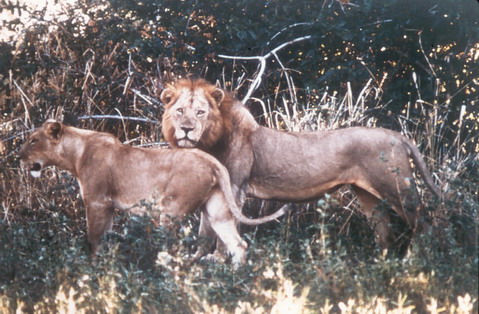
In addition to birds there were a greater number of different types of animals in South Luangwa. In fact, on the first morning out, we saw the same three of the five “big five” I saw in Kenya: the cape buffalo, African Elephants, and a pride of lions. The were a greater number of elephants, baboons, vervet monkeys, warthogs and hippos here than in Kenya. In fact, the elephants regularly came through our camp.

“Watch out for the elephants and don’t get within thirty meters of them.” We were told on our first day. Later that night, I had went back to our tent to take a shower before dinner.

It had gotten dark but I told Scott and Gina I would meet them in the self catering kitchen midway through camp. Self catering was a bit more of a challenge because a previous camper did not store fruit properly and a elephant ripped off the door and and destroyed the refrigerator the previous night. Still visible was the crack in the cement wall of the kitchen the elephant had left behind. They had replaced the door but the refrigerator would not be replaced for a few days. So we had to store our food at the main kitchen on the other side of camp.

I followed my guide to the kitchen. We turned the corner and 20 meters away was a elephant just outside the door. I could see Scott and Gina busily working away. “Are my friends aright?” “Yes, the is a guard near. But we need to go this way.” We headed right, away from the kitchen, towards the main lodge. “I don’t really need to eat tonight.” I responded. Thinking I would just go to bed without dinner. “No. It will be just fine. Come this way.” I followed but looking behind the I saw the elephant’s truck reach toward the screen door of the kitchen.

We made a wide circle around the area and came back from behind the elephant who had moved a few meters forward. “Hurry in now and lock the door” the guide told me. I tapped on the door, “Hey, can you guys unlock the door.” “Sure, what’s the rush?” Gina stated as she walked calmly to the door. I was surprised that Scott and Gina had not heard the elephant right outside, not even a foot away from the screen. For such a large animal with big feet I am always surprised how quiet they are in the wild. We did finish dinner and I was grateful to get safely back in our tent that night.

The monkeys and baboons were all over the camp. The are so cute until you realize that you must watch out for those fast moving creatures. Our first run in with a monkey came at the lodge when Scott and I had grabbed a piece of fruit out of storage for a snack. We had Gina’s apple on the table waiting for her and we see this cute little monkey coyly approaching us with big beautiful eyes. “Oh. Look at the monkey.” Then with one leap to the table the beast grabbed the apple and was off so fast we did not know what to think.

“Where’s my apple.” Gina stated later as she arrived to the lodge. “Too late.” Scott replied. “Monkey got it.” Then a couple days later one of the two nuisances destroyed our front porch. It was obvious they had tried to get into the tent but we had it locked. They did however, defecate all over our bathroom which had an open air ceiling. After learning their tricks and knowing when to clap our hands or alert their presence of staff we found that they could be managed.

Ralph was also right about it being hot in the in South Luangwa. Everyday it was between 40 and 49 degrees Celsius; That’s 100 to 120 degrees Fahrenheit. This is the hottest part of the year, before the rains. Most wildlife was huddled near any body of water left. Baby impala and puku had a difficult time surviving due to the heat and lack of water. Drives were scheduled to avoid the hottest part of the day. Morning drives were scheduled between six and ten.

We would have tea at 3:30 in the afternoon and start our night drive promptly by four. Vehicles had to leave the park at eight in the evening. We spent most of the afternoon hours in the pool. Gina and I started wearing our swimsuits to the morning drive so we could hop right in the pool when we returned. The sunsets were glorious and after dark the spotter used a white light to search for the wildlife. Early morning and after dark was the best time to find the cats.  

They, like us, wanted to be in the shade during the day. The night, however, was the best time to view a kill as the cats had an eyesight advantage after dark.

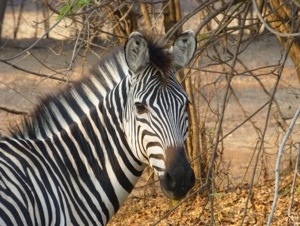
On our drives we also saw crocs, giraffes, zebras, impalas, albino frogs, three genets, a civet, mongoose, porcupines, hyenas, puku antelope, a water monitor, kudus, water bucks and bush bucks. The kudu were wonderful tan colored, deer-like creatures with vertical ivory stripes. The large and rare water buck had a big circle around it’s tail. It was five drives or nearly eighteen hours of searching to find the animal I most wanted to see.

“South Luangwa is your best chance to see the Leopard.” Ralph, from the Asilia Camp, had told me when I was in Kenya. And we found it just when I had almost given up hope.

Just before sunset Alan, our guide, stopped the car and looked to the distance. During the drives, especially in the daylight, I have spotted most of the animals right away. I look out and see nothing. I turn my head to Alan to see what direction he is looking. I turn back and still see nothing. The spotter in the back says something to the guide and we wait and scan the land. Finally Alan says, “Leopard. I am sure of it.”

“Where?” I reply. “It has to be over there. See where the impalas are looking.” He continues, “I first heard the screech in the distance of the baboons. Now, hear the impala’s they are whistling to each other.” I did not notice the call of the baboons to be any different than in the camp when they had gotten excited but I clearly heard a short whistle coming from the impalas. I had not heard that sound before in Africa. “How do you know it is a leopard and not a something else? If it is a leopard why aren’t they running.” Alan replied,

The leopard is alone and they are faster than the leopard. As long as they know where he is, they can outrun it. The leopard must have the element of surprise to be successful. That is why they usually don’t hunt during the day, they wait for the night to hunt when the impala can’t see as well. The leopard’s advantage at night is in it’s ability to see in the dark.”

We continue to stare off into the direction the impalas are looking; Towards the dry vegetation. “Can we get any closer?” I hear from behind. A minute later I hear Ilya again. “Can we get any closer?” Ilya and Marian have been on all of our drives with Alan. They have meetings in the capitol but came up to South Luangwa for a side trip while they are in the country.

Ilya started taking pictures as a hobby but has had pictures appear in the National Geographic magazine. He had the biggest camera lens I have ever seen in my life. I turned and saw Alan contemplate his question. “You can’t get over there. Can you?” I reply. There is a strict policy of no off-road driving in the game reserve. I could not see a road leading us to where the impalas were looking. Alan replies, “I don’t see a way.”

A moment later, Alan starts the car and turns on the cracked cotton dirt with large splits earth. The Land Rover bumps up and down. I didn’t realize how deep the fissures in the earth were until that moment. Up, down, up, down the vehicle stops in a crevice. Alan restarts the vehicle. I hold on to the handle bar in front of me. And look out the side of the Land Rover where the door would be. Alan had me sit in the spotters seat that trip. The side doors and windshield had been removed to allow for easy viewing of animals and tracks in the dirt.

 Now it gave me a clear view of the earth as the vehicle tipped sideways in another fissure in the earth. I think to myself, “Oh no, we are going to be stuck here.” And I wonder if our guide will get in trouble for going off road. Then I think to myself. “I am a sitting duck to that leopard out there.” I hold my breath. Alan restarts the engine and we are half way to the location the impala’s were watching. We move forward. “There it is.”

I look ahead and finally see a hind leg and tail of the crouching leopard moving quickly to the small thicket of dried brush. I can not believe how his coat blends in with his environment. We are about half way to the brush from where we left the road. I can’t believe that this is the second time in my journey a guide broke the rules for something I really wanted to see.

“I am afraid it’s gone.” Alan says as we drive closer to the thicket. “I didn’t see it leave the thicket. There is a blind spot where we couldn’t see but it could be there.” I reply. We turn gradually left and make our way around the small thicket. The passenger side, my side, of the vehicle is towards the five meter in diameter brush we saw the leopard run toward.

All eyes were on the brush; Cameras ready. Then I hear a deep, long roar which ended in a high pitch and I was eye to eye with the leopard. Faster than a snap of a finger the leopard pivoted and ran in the opposite direction. I didn’t even lift my camera at first as I realized my feet were about three meters from that leopard. There was a split second I had thought I was going to be its meal.

As it pivoted I saw the incredible strength in it’s hind legs. Every muscle worked in perfect unison to go from zero to a full sprint instantaneously. The feet all came together an out so quickly. I stood up, turned and just watched. Then, I remembered my camera. I snapped two pictures and then he was gone. It was a large male and he was so big, so fast. I had seen the leopard and he was beautiful.

Original Post:
http://evonlagrou.com/tag/south-luangwa-national-park/


Wednesday, October 24, 2012

Norman Carr Safaris’ first “wildly luxurious” lodge in Luangwa Valley

Norman Carr Safaris (NCS) has revealed details of the first “wildly luxurious” sustainable bush camp in Zambia’s game-rich Luangwa. Scheduled to open in March 2013, the Chinzombo camp is being designed by acclaimed architects Silvio Rech and Lesley Carstens, the visionaries behind North Island in the Seychelles and Little Vumbura Camp, an eco-luxe lodge in Botswana’s Okavango Delta. The architects’ signature style is low-impact eco design, using sustainably sourced materials as well as local building methods and craftspeople.

Chinzombo represents another step in the evolution of the Rech and Carsten luxury bush camp design philosophy. For the first time, modernist architectural forms are being combined with the organic geometry and regional materials of indigenous Zambian building methods to create a new, groundbreaking type of bush camp.

Built on the site of one of Norman’s original camps, Chinzombo comprises six WiFi-equipped spacious villas, one with capacity to accommodate a family of five. The villas, which appear to float over the landscape, are nestled within the shade of ancient trees on a ridge which follows a loop in the Luangwa River. Minimalist in design, the villas’ modern steel-framed structures contrast with the natural materials used in the décor and interiors.

The villas contain large, cooled bedrooms, luxurious bathrooms and private plunge pools on shady decks overlooking the Luangwa River. Materials are natural, including locally-produced leather, reed-work and canvas while floors are made of recycled composite timber. There is little concrete or brick, and the décor features raw linen, timber, copper and hand-made crockery. Local weavers, pottery makers and carvers have been commissioned to create many of the interiors.

A winding foot path shaded by mahogany trees connects the accommodation and lounge/dining area. Fitness fanatics will find a yoga and exercise area and spa facilities; nature lovers will appreciate a place where both wildlife and natural vegetation flourish, unhindered by vast tracts of landscaping, game fences, roads or other man-made installations.

Chinzombo honours its history: conservationist Norman Carr promulgated experiencing the African bush while respecting both the natural landscape and local traditions. Today his philosophy is called “sustainable tourism.”


Original post:


Wednesday, October 17, 2012

Norman Carr Safaris Offers “Elephants Never Forget” Discount

Norman Carr Safaris (NCS) is offering past guests an “Elephants Never Forget” discount of 15 percent on a seven-night safari to Zambia. Accommodations are at NCS’ flagship Kapani Lodge and at Kakuli. From March 1 accommodations will switch from Kapani to Chinzombo, a new, luxurious, sustainable safari accommodation in the Luangwa Valley.

To qualify for the discount, at least one member of the party must have stayed with NCS sometime in the past. Just submit names and dates of prior visit, so NCS can verify. The offer only applies to the seven-night Rivers and Rainbows safari, which runs from Jan. 15 to April 5, 2013, subject to availability. Once new guests have stayed with NCS, they will also qualify for the 15 percent discount on future Rivers and Rainbows safaris.

The green or emerald season of the South Luangwa is known for magnificent sunsets and skies, many migratory birds, clear night skies and occasional dramatic tropical downpours. South Luangwa National Park is considered one of the greatest wildlife sanctuaries in the world, with a tremendous concentration of game around the Luangwa River and its oxbow lagoons.

Original post:
http://www.travelpulse.com/norman-carr-safaris-offers-elephants-never-forget-discount.html

Thursday, October 4, 2012

Norman Carr Safaris Offers Discount to Zambia’s South Luangwa Valley


In order to promote travel to Zambia’s South Luangwa Valley in the green season, Norman Carr Safaris (NCS) is offering Elephants Never Forgetto all past guests. The promotion features a discount of 15 percent on a seven-night safari. Guests will stay at NCSflagship Kapani Lodge (or, from March 1, at Chinzombo, the first wildly luxurious, sustainable safari accommodation in the Luangwa Valley), and at Kakuli, the only true bush camp open in the green season.

  To qualify for the discount, at least one member of the party must have stayed with NCS sometime in the past. When booking, you must submit names and dates of prior visit, so NCS can verify. The offer only applies to the seven-night Rivers and Rainbows safari, which runs from Jan. 15 to April 5 and is subject to availability. Once new guests have stayed with NCS, they will also qualify for the 15 percent discount on future Rivers and Rainbows safaris.

The green or emerald season of the South Luangwa is characterized by magnificent sunsets and skyscapes, a myriad of migratory birds, crystal-clear night skies and occasional dramatic tropical downpours, making it a dream for photographers, birders, wildlife lovers and adventurers. South Luangwa National Park is considered one of the greatest wildlife sanctuaries in the world:

For more information on Africa, visit Sell Africa Travel.

Sunday, September 23, 2012

Kapani and history of the company


Kapani and history of the company

Norman Carr established Luangwa's first safari camp in 1950. Back in the days when an African safari was a hunting experience, Norman developed the pioneering idea of taking people to look at animals and photograph them rather than to shoot them.

This first safari camp was set up in partnership with the then Paramount Chief Nsefu and his people. This idea of involving the local people in the management of the wildlife was way ahead of its time. It was almost 50 years later that conservationists started developing the principles of "Community Based Natural Resource Management", in other words encouraging the traditional owners of the natural resource to take responsibility for its usage. Norman Carr's pioneering approach proved to be the forerunner to a cornerstone of modern day conservation policy.

The first 35 years of the company saw Norman set up and establish a number of safari camps across the Luangwa Valley, some of which are still in existence – Nsefu, Lion Camp, Chibembe and Chinzombo to name a few. In 1985 whilst running his safaris out of the old Mfuwe Lodge, Norman started construction on what would be his final safari camp, Kapani Lodge. He selected an elevated site overlooking the Kapani Lagoon. He knew the unpredictability of the Luangwa River well, and that this site would never flood and would never fall into the river.

Everyone associated with Norman Carr Safaris (NCS) is immensely proud of the heritage of the company. The principles of conservation and community responsibility established by Norman over half a century ago still run strongly through the company. We have been leading the way in responsible tourism in Zambia for over 60 years and we intend for that to continue.

In early 2012 we announced our new partners – the Dalais family and Chongwe Safaris in the Lower Zambezi – who along with co-owners and Directors Dave Wilson and Christina & Adrian Carr are pleased to share the next chapter of the Norman Carr Safaris adventure.

Throughout its history, NCS has always innovated; the first community based tourism, the first camps, the first walking safaris, the first community projects, the first luxury bush camps, the first all Zambian expert guiding team, the first Zambian female guide, the first majority Zambian Operations Board - the list of firsts is long!

We’re proud to continue this tradition and will continue to lead the way in innovation, the use of new ‘green’ technology, staff training and development and community involvement.

For Norman Carr Safaris, it has always been and continues to be all about CONSERVATION THROUGH TOURISM.

Original: http://www.normancarrsafaris.com

And a picture gallery: http://www.normancarrsafaris.com/#!/gallery/Camps/Kapani