Monday, April 28, 2008

When to Travel to Luangwa

There is no best season to come on safari as each season brings its own delights. There are different aspects to every month of the year:

• The green season (November – March) is the most spectacular time for birdwatching, with all the migrants arriving to breed and displaying their bright plumage and intricate song.

• The month of May is the busiest month as it is the impala's rutting season. The bush is now full of the snorts and grunts of male impala that busy themselves either seeing off the competition or trying to impress the females.

• As the bush dries rapidly, stark changes take place over the next few months. The lagoons, already separate from the river in most cases, slowly dry up and disappear. Large herds of buffalo, elephant and other animals gather at the river's edge to take advantage of the permanent supply of water and one gets the feeling that everything is leading inexorably towards the onset of the rains once more.

Although the Luangwa and our company in particular are famous for walking safaris, we like to offer variety to all our guests. You will always have the choice between walking and driving but we strongly recommend a combination of both.

Driving Safaris

Most of our safari vehicles have only two rows of seats and we prefer not to put more than four guests in a vehicle. We do have a larger vehicle for families and small groups but we like to ensure that everyone has a window seat - not that our vehicles have windows of course - in Zambia we are lucky to be allowed completely open vehicles in our National Parks enabling you to be as close as ever to the animals you are watching.

Game drives generally take place just after sunrise and around sunset. You will follow the loop roads in the park, stopping to view wildlife and for the quides to offer you their observations. Morning safaris will include a stop for tea or coffee. You will return to camp at around 10am. Evening safaris will include a stop at sunset for Sundowners – aperatifs served by your guide. The safari will then continue after nightfall viewing nocturnal wildlife, and returning to camp in time for dinner.

Walking safaris

Norman always maintained that to view the bush from a vehicle was to observe, but to get out on foot was to become instantly a part of your surroundings. Anyone experiencing a walking safari will concur that to stand and see the flick of a lion's tail as he disappears behind a bush 100 yards away, incensed and mystified by your presence, is infinitely more exciting than to sit in the safety of a jeep within inches of the same creature.

Zambia’s Luangwa Valley is regarded as the home of walking safaris. In recent years many private reserves and National Parks across Africa have caught on to the trend but nowhere yet comes close. The level of training required before qualifying as a walking guide and the concept of an armed escort as well as the naturalist guide leading each walk, mean that the emphasis in the Luangwa is on getting up close and personal to big game.

Our four bushcamps are positioned such that we can offer a trail combining any number of the camps. Your safari will take on an expeditionary feel as you walk from one camp to the next. We have camps both on the Luwi River (one of the Luangwa’s primary tributaries) and on the Luangwa itself. Your guides will point out the significance of the changing habitats as you walk through the Valley enjoying a complete safari experience.

http://www.normancarrsafaris.com/safari.shtml

Saturday, April 26, 2008

Zambia: Born to be wild (+photos)

So kids," I say, dragging out a kindly voice from my schoolteaching days and turning to the children seated behind me in the four-wheel drive, "which animal do you most want to see on safari?"

We're about to leave Lilongwe, the capital of Malawi, and head across the Zambian border for a five-day safari in remote South Luangwa National Park, and have just met the British family of five who will be our companions on the trip. Rosie, 10, answers first: "Elephants and hippos and zebras and giraffes."

At 12, Josh is more decisive. "Wild dogs," he says, choosing one of the rarest, most elusive carnivores in all Africa.

Sam, who is 8, has his nose buried in the latest Harry Potter book. His head is too full of hocus-pocus at Hogwarts to give a definitive answer, but the African wilderness is about to create its own magic - for all of us.

Our cheerful guide Ben, from Land and Lake Safaris swings up into the big Land Cruiser and we're soon chewing up the kilometres towards the border. Once in Zambia, the going is slow, hot and dusty as we negotiate 100km of rough dirt road, passing through forests and scattered villages of thatched huts where villagers stop to watch the unfamiliar vehicle bounce by. It's fascinating, but everyone sighs with relief when Ben says we're nearing our lodge.

Rosie gets one of her wishes before we even arrive when we jolt around the final corner to find the track blocked by a herd of elephants.

The rigours of the drive melt away as we sit in awe, watching them use their dextrous trunks to tear at trackside trees before they amble off into the bush.

On arrival at the lodge, strange noises draw us to a bank overlooking the Luangwa River. Several large crocodiles bask on a sandbar in the middle. Just below us the nostrils, eyes and ears of a dozen hippos are visible above the murky water. Every so often a hippo surfaces, opening its cavernous mouth to let out a mournful bellow, a sound that becomes synonymous with our stay.

South Luangwa covers 9050sq km, with the twisting course of the Luangwa River at its heart. This seldom-visited park has one of Africa's highest concentrations of game, so with that in mind we retire early to get a decent sleep before our first game drive. The hippos and the trill of myriad insects and frogs disturb our slumber, as do elephants cavorting in the overflow from the nearby water tank and ripping at low trees right outside our window.

Still, lack of sleep doesn't dull our anticipation and we set off at sunrise, wrapped up well against the chilly African morning.

Just over the bridge into the park our safari guide, Flemings, opts to take one of the smaller trails.

We've been on it only two minutes when someone whispers loudly, "Wild dogs".

Everyone looks sceptical, but Flemings obligingly reverses our customised open-top vehicle and noses off the track, crunching through the thick undergrowth. Sure enough, there in a clearing, six wild dogs are devouring an impala they've just killed, their white-tipped tails wagging furiously and their mottled coats stained with blood.

The dogs, also known as Cape hunting dogs or painted wolves, aren't going to give up their kill because of us so we're able to edge in close.

In the tall, tawny grass we spy a spotted hyena greedily eyeing the dogs' meal. He tries to slink in beside them but is smartly chased away, with a sharp nip thrown in for good measure. Soon the dogs have had their fill and lope away, bloodied tongues lolling as they run. Immediately, the hyena moves in, making short work of the carcass as his powerful jaws crunch through bones and skull.

So Josh gets his wish with the unexpected sight of the endangered dogs and a scavenging hyena.

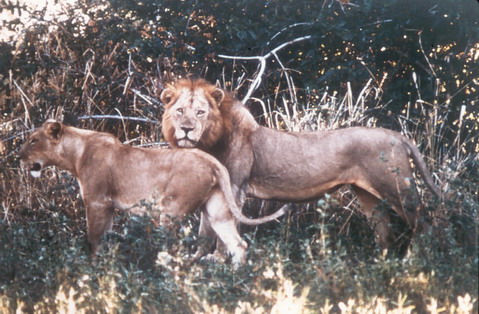
It will remain a highlight, but there are many more to come. During our stay we have three lion encounters, one of which involves a lonely lioness stalking a handsome male and another female. While we're engrossed watching the pair in front she sneaks alongside us, using the vehicle as a shield.

The British children's mother, Louise, gasps as the lioness passes within centimetres of Rosie, who has opted to sit in the door-less passenger seat.

But the lioness moves on to confront the other lions. The angry male snarls and lunges, chasing her behind a tree where she curls up sadly like a rejected kitten. The last we see of them, the single lioness is watching forlornly from a rock as the pair saunter away across a dry watercourse.

Later we come across a herd of about 600 Cape buffalo and, when we stop near a waterhole for morning tea, a dozen zebra step down to drink - nervously watching us as well as the hippos and crocs. Giraffes, elephants, zebra and warthogs regularly cross our path and impala become so commonplace that we barely notice them.

We do notice the incredible variety of birds and with Flemings' help we are soon able to identify gorgeous lovebirds, weird ground hornbills, various water birds, kingfishers and birds of prey.

South Luangwa has a good population of leopards and during night safaris we hope that the powerful spotlight will pick up one of the big cats. It doesn't, but we see other nocturnal creatures, including genets and civets, mongooses, hares, hyenas, and hippos that have come out of the water to graze.

Our final great experience comes at the last sunset of the trip when we stop to watch the blazing red ball sink below the forest.

In the river behind us hippos moan and groan, while in front of us three enormous elephants materialise out of the trees and stroll across the open ground. All of our safari wishes have come true.

http://www.nzherald.co.nz/section/7/story.cfm?c_id=7&objectid=10505200

Monday, April 21, 2008

Get there before the rush

After the rainy season, Luangwa Valley is spectacular, the weather superb, the game as prolific as ever, and while the camps begin to re-open, May and June are traditionally quiet months - a great time to visit the Zambian bush before the crowds! Tailor-made natural history specialist Wildlife Worldwide offers a last minute discount of over 20% on a special 9-day Leopards of Luangwa safari, spending 8-nights in the Valley and 1-night at Pioneer Camp in Lusaka, for travel between 28th May and the 30th June 2008. Tours depart Heathrow once a week.

The holiday is based in Zambia’s South Luangwa National Park, the jewel of the country's national parks, comprising 9,050 square kilometres of unspoilt African wilderness. With accommodation at Kapani Lodge, once home of Zambia’s most famous conservationist, the late Norman Carr, and its satellite bush camps of Luwi, Nsolo and Kakuli, guests can explore a different habitat at each location. Experience the rich wildlife viewing opportunities of the broad banks of the Luangwa River, the edge of open grassland or mopane woodland close to a waterhole.

Enjoy expertly guided walking safaris – something for which the Luangwa is renowned, morning and afternoon game drives and night-time safaris with spotlights. Luangwa Valley offers a rich diversity of wildlife and in particular, is home to Africa’s highest naturally occuring Leopard population.

Of 60 other resident mammal species recorded, Lion, Elephant, Giraffe, Hippo and Cookson’s Wildebeest feature high on the list together with an exciting array of over 420 birds including some of southern Africa’s most colourful species. The final night is spent at Pioneer Camp in Lusaka, located in quiet bush and farmland, amongst 25-acres of wide open spaces and exquisite Miombo woodland, before homeward flights next day.

http://www.easier.com/view/Travel/Holidays/article-174990.html

Saturday, April 12, 2008

Luangwa: The Hollywoods return!

Two nights ago the camp was full of lions but by daybreak yesterday morning they had moved into some combretum thickets near the workshop. They were very relaxed and I was able to approach quite close on foot. Unfortunately they were extremely well hidden and impossible to photograph. Last night they were out and about again and we had a few fleeting glimpses by torchlight as they moved around the camp. I counted 4 adults (1 male, 3 females) and 7 cubs. They were around at first light this morning for a short time before disappearing into even thicker vegetation.

I was very keen to find out which of the cubs has survived the rains (as I’m sure those of you who have been here and know these lions are too). I didn’t see them all at once though so difficult to tell. I think there are 4 left of the group of 5 that I last saw in December. Out of the 2 smaller cubs only 1. There was then another 2 cubs that looked about 3 months old - so new ones to me, born during the rains. Hopefully I’ll have a good sighting soon so that I can confirm this. It is really encouraging to see so many though as this pride does not have a good track record for raising cubs.

Those of you who are wondering why they are called the Hollywoods - this was a nickname given to the Lion Camp pride due to all the attention they received from a documentary film crew who were here a couple years ago. They’re also rather glamorous!

http://livingluangwa.com/2008/04/11/the-hollywoods-return/

Wednesday, March 26, 2008

The Luangwa Valley

The Luangwa Valley is at the southern end of the east African rift valley system.

One of the continent’s least known rivers, the Luangwa with its palm fringed lagoons, winds 400 miles through the Valley to join the mighty Zambezi.

A tsetse fly and malarial zone, it is inhospitable to farmers and has traditionally been the territory of hunter-gatherers.

Historical records of the Valley began with the arrival of the Portuguese in the 16th century;

Livingstone was one of the early British explorers to cross the Luangwa River.

Slave traders from the Indian and Atlantic Oceans, of Arab, European and African origin, all preyed on its peoples.

Read more at:

http://www.liv.ac.uk/sace/research/projects/mfuwe/luangwa/index.html

Saturday, March 22, 2008

Canoeing the Luangwa

Our friends John and Carol Coppinger set off on a ten day canoeing trip to the Luangwa/ Zambezi confluence this week.

Sarah and I joined them for the first (65km) leg to Mfuwe. It was a wonderful day although a little hair raising at times as the crocodiles suddenly become very inquisitive when they see you floating past.

John has actually had one bite through the front of his canoe before!

http://livingluangwa.com/2008/03/21/canoeing-the-luangwa/

Wednesday, March 12, 2008

I lost my heart to Zambia

A trip to Luangwa Valley, Zambia proved life changing for Wild Notebook columnist Simon Barnes

I got up before dawn to say farewell. One of the great times of my life was ending. I had been here for two months, on an all-but-ruinous self-imposed sabbatical. I had stayed at the same camp on the Luangwa River in Zambia, slept in the same hut, driven the same drives and walked the same walks. Now it was over.

Outside my hut – a sort of largish laundry basket containing a bed and a table – lay the deep, hollow bed of the river. After an endless expanse of beach, you could at last make out the knee-deep trickle of the river itself: at its last gasp, waiting for rains. The camp had to be dismantled that day, before the rains came, and I had to say farewell to the people I had shared the place with and start making my way back to real life. Or back from real life: you decide.

I had seen wonders. I had been on terms of the closest possible intimacy with a pride of lions. I had been charged by an elephant while on foot – not very seriously charged, she turned away at a nonchalant handclap from my cool-in-the-bush companions.

I had seen crocs in teams of a hundred and more, I had seen the air turn into flame at the carmine bee-eater colony. I had walked with impala and puku, gazed at kudu and eland; I had followed leopard on their wild night-hunts and watched them kill. In short, I had lost my heart: or a piece of it, anyway.

I have my notes for that last day. For some perverse reason I only recorded the creatures I identified by ear. Hard to remember why: but I suspect it was an expression of my intimacy with the place. I no longer had to look in order to know. All my senses were now bush-senses. I was not an outsider looking in: I belonged. My ears told me that.

Six species of mammal, then: the distant crump of lion, the explosive scolding of a baboon spat, the dirty-old-man laughter of hippo from a still-deep pool of the river, the bark of impala, the last noise you’d expect from so frail a beast, and behind camp, the log-sawing roar of leopard.

I also noted 30 bird-voices; not so many, perhaps, but then I was only at it for an hour or so. On one day, a reasonably leisurely one, I had recorded 134 species in a single day, a record that has since been beaten many times. At that time, I could put a name to every cough and trill and tinkle. It was a matter not just of listening but also of belonging.

What I like best about the Luangwa Valley is absolutely everything. The totality of the environment is the thing. I love above all the way the place sucks you in, the way you cannot help but become a part of it. And everything you do is spiced with just a little whiff of danger, to make you feel more alive than is possible anywhere else, because, of course, the place is full of things that can kill you.

So I noted the orange-breasted bush shrike, which sings Beethoven’s; Fifth, and the distant booming of ground hornbill, and the sweet whistle of black-naped oriole, and the rest; lion roaring in the distance. There was, inevitably, a clamorous farewell from the African fish eagle: the very sound of the valley. And then I left.

Ah, but that’s the most terrible lie. I’ve never left. I’ve been back, a dozen or so times, but in a way, that hardly matters. The fact is that the place has become part of me. When I go back, I see new wonders, and I become reacquainted with the same old wonders seen a hundred times before. But I don’t really mind if I see nothing at all. I demand nothing of the place. I just need to breathe the valley air: to know that there are wonders out there still. Whether or not I see them myself hardly matters any more. It’s just good to get back in touch with that missing piece of my heart.

http://www.timesonline.co.uk/tol/life_and_style/related_features/love_nature/article3537153.ece