Tuesday, December 2, 2008

Bush Camping with Norman Carr Safaris - "Return To The Wild"

For a number of years now we have been keen to offer a select few guests something further out of the ordinary. Whilst most guests regard our bushcamps as one of the most remote experiences they could contemplate, a few find themselves hankering for something a little more “out there”.

We were therefore thrilled when some guests expressed an interest in camping out in the bush. They declared their interest long before their arrival in Zambia so we were able to make detailed preparations for this safari, during which a group of four guests accompanied by Abraham Banda, Dave Wilson and our top escort scout John Saili set out from Kakuli walking to Nsolo, with a night-stop on the way. Dave recounts the experience below:

Setting up Camp The weather was perfect for walking, slightly overcast with a cool north easterly breeze. We began our adventure from Kakuli camp with our four guests, the omnipotent Abe, indestructible John Saili and myself making up the merry band of men embarking on a true wilderness experience. The plan was to walk from Kakuli to a predesignated spot on the Luwi River where provisions had been dropped for us to stay overnight, before walking into Nsolo camp the next day.

As we set off, there was an excitable nervousness amongst the guests - quite understandably given that, from the comfort of a vehicle, they had witnessed a battle between the eternal enemies Lion and Hyena over a fresh carcass the previous night; but now they were going to be on foot and also sleeping out!

The walk was fantastic as we wound our way up the spectacular Luwi sand river. There were numerous elephant herds along the way, some of which were digging for water in the sand river and spraying themselves with clouds of dust and sand. We expertly navigated our way around the herds upstream through forests of huge red mahogany and stands of adrenaline grass. Abes spotted the spoor of a big eland bull and lo and behold, there he was thirty metres further on, in all his glory. A massive Eland Bull on the edge of the river, chocolate and sand in colour, he stood watching us and then nonchalantly moved into thicker grass.

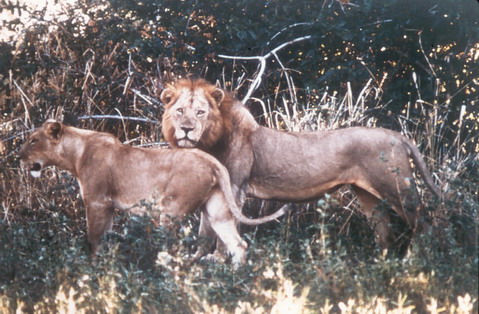
Not more than 100 metres upstream we walked into three big male lion. At a distance of 60 metres we peered over the top of a termite mound to be met by the lions' intense gaze. One of them took umbrage at our presence and in a characteristic manner let us know in no uncertain terms that we weren't welcome, with a bone chilling growl and swishing of tail. It was an unforgettable scene with us on foot, the lions staring at us, and two herds of elephant in the background. With, needless to say, a spurt of adrenaline, we circumvented the lions, walked down into the river bed between the two herds of elephant and continued our walk through the Garden of Eden towards the campsite.

The approach to the site could not have been better scripted - with the bright yellow flush of Long Pod Cassia tree flowers in stark contrast to a cobalt blue sky, the golden rays of the sunset highlighted a large herd of impala whilst baboons played in the Tamarind tree and yet another lone Eland bull browsed on Bush-willow. To cap the walk off, we spotted a beautiful bull Cookson's wildebeest running in the distance, stopping to look back at us before continuing his rocking gait through the Leadwood forest.

The site of our camp was on a bend in the river, out on the white sand beneath a couple of Red Mahoganies. Bedding consisted of bed rolls, mattress, and a couple of sheets and blankets. It was the duty of each guest to make his bed in the dry river bed - done with banter, a couple of beers and much fervour due to the impending darkness. Fires were lit all round and popcorn prepared and washed down with more beer - we were settled in for the night!

Cooking Dinner Dinner consisted of an aperitif of borevors followed by a main course of marinated steak on the fire, potatoes and honey glazed carrots cooked in the coals with a chilli, tomato and onion sauce. Naturally red wine was the choice of beverage! The campfire stories unfolded with much aplomb and amusement. Everyone settled down with their backs against an old Leadwood trunk watching bush TV (the fire) whilst the night came alive around us, with the ever-present sounds of frogs and crickets, the whooping sounds of Hyena in the distance and the distinctive dueting shrill of the diminutive African Scops owl above.

As eyelids drooped we headed for the bedrolls, except for the indomitable figure of John the scout along with Abe who continued to stoke the fires and keep watch for any unwanted visitors. As the breeze died down we were woken by the whine of mosquitoes so deployed the nets and recommenced our dreams in this truly remote wilderness far from the madding crowd.

Morning Camp We awoke in the early morning to the snort of impala and bark of baboon - possibly a leopard moving across the river bed. The coals were stoked and a kettle put on to boil for tea and coffee all round accompanied by the retelling of the mosquito and hyena exploits of the night. After a quick mouthful of biscuit and fruit we proceeded to pack up camp, dousing the fires so as to leave no sign of our stay other than footprints, and then set out for Nsolo camp. On the way, signs of honey badger, civet and hyena gave the group an insight into the activities of our nocturnal friends. Fresh lion droppings and a sighting of eight hyena on the plain in front of Nsolo told us another story of what had happened during the night under the same sky. And then on to Nsolo for a full English breakfast and to recount the experiences and stories of our return to the wild!

Dave Wilson

http://www.normancarrsafaris.com/cm/about_us/your_hosts/up_front/bush_camping

Friday, July 18, 2008

Local community should protect wildlife

In 1986, Mark and Delia Owens established the North Luangwa Conservation Project (NLCP) to rehabilitate and conserve the 2,400-square-mile North Luangwa National Park of Zambia.

At that time, commercial meat and ivory poachers had killed all of the park\'s 2,000 black rhinos and they were killing 1,000 of its elephants each year.

In the previous decade, poachers had slaughtered up to 100,000 elephants and virtually all of 6,000 black rhinos in the Luangwa Valley as a whole.

They set wild fires that burned over 85 percent of the area every year. If left unprotected, by 1996 North Luangwa would have been sterilized of its large mammals.

The government did not have the resources to adequately protect or develop the park. So Mark and Delia`s first priority was to curb poaching by helping improve the efficiency of local game scouts.

They provided them with patrol food, camping equipment, trucks, houses, an operations center, training, radio communication, a school for their children, medicines, and cash incentives.

After working closely with them for years, the North Luangwa game guards became the best in Zambia.

At the same time, Mark and Delia selected 14 villages located near the park that were notorious for harboring commercial poachers.

In fact, poaching was the primary industry in the area, providing more jobs and more sources of protein than any other.

So Mark and Delia began NLCP\'s Community Development Program, establishing small sustainable businesses which provided basic goods and services to the local people and alternative legal jobs to poachers.

This program was not a handout. Each business was run as a free enterprise, and the entrepreneur had to repay his initial start-up loan, so that the project could then help others start their own businesses.

In this way, NLCP supplanted an illicit economy based on poaching with a legal one, thereby undercutting large-scale commercial poachers who hired hunters and carriers from the villages.

In the past, many villagers traded poached meat for ground maize, their staple diet. NLCP helped them form ``wildlife clubs,`` which used NLCP business loans to purchase and run grinding mills, offering employment to millers, mechanics, and bookkeepers.

In some villages these same clubs also used loans to open small general stores, which sold soap, salt, matches, and other basic commodities that people formerly could purchase only by walking days to Mpika and other towns along the main Cape-to-Cairo Road.

Villagers also traded poached meat for cooking oil, a much prized commodity in rural Africa.

As an alternative, NLCP taught them to grow sunflower seeds and press them for oil using simple hydraulic presses, once again replacing poaching with a sustainable legal trade.

Other cottage industries that provided jobs, food, or services to the local people were carpentry shops, fish farms, poultry units, bee keeping, sewing coops, rat trap makers, and cobbler shops.

NLCP also assisted subsistence farmers with seed loans, transportation and technical assistance to help them grow protein-rich crops with better yields so they did not have to depend on meat from wild animals.

More than 2,000 families in the NLCP target area benefited from NLCP\'s Community Development and Agricultural Assistance Programs.

Mark and Delia also established the NLCP Conservation Education Program in these same target villages. Many students had never seen a color photograph and schools lacked even the most basic supplies.

The NLCP Education Officer visited schools monthly, offering a 500-volume mobile library, curriculum guidelines, school supplies, wildlife slide shows, lectures, and drama competitions, all with a conservation message.

Forty-eight American schools participated in a ``Sister School Program,`` a conservation oriented exchange program with NLCP\'s students exchanging letters, art work, reports, and essays.

American schools sent letters, school supplies, books, and donated magazines to their Zambian counterparts. These Zambian students, it is hoped, will not grow up to be poachers.

NLCP\'s Rural Health Program taught hygiene, first aid, preventive medicine, family planning, and advanced clinical techniques to village medics.

NLCP trained and equipped 48 ``traditional birth attendants`` to assist the pregnant women in the villages near the park. Traditional birth attendants also taught AIDS prevention, early childhood development, and nutrition to the women of their villages.

The ultimate goal of NLCP was to ensure the development of a low-impact tourism industry for the North Luangwa National Park, an industry that would provide employment opportunities and development revenues for villagers who would otherwise depend on NLCP or poaching for their livelihood. Mark and Delia worked with the government to design an enviro-friendly tourism development plan for the park.

The North Luangwa Conservation Project was remarkably successful. When Mark and Delia arrived in 1986, 1,000 elephants were being poached every year. From September of 1994 to May of 1997, not one was killed in the Project area.

For the first time in 20 years the elephant population of NLNP increased slightly, and villagers reported elephants, buffalo, hippos, and other large mammals in areas where they have not been seen for two, even three decades.

Wildlife research and ecological monitoring documented the recovery of the elephants and other animal populations.

Thirty-five elephants were collared with radio transmitters and aircraft were used to chart their range movements, habitat utilization, group size, social structure, and reproductive success.

The people near North Luangwa no longer had to poach, or collaborate with commercial poachers to feed their families.

The heads of more than 2,000 families, many of whom were once involved with poaching, had legal, sustainable jobs.

Leaders from villages beyond the NLCP area began asking how to start NLCP programs.

NLCP has been declared a model for integrated rural development using techniques that involve non-consumption of wildlife resources.

http://ippmedia.com/ipp/guardian/2008/07/18/118728.html

Sunday, July 13, 2008

Hot Spot: Puku Ridge Camp, Zambia

This newly opened lodge is located in South Luangwa National Park, a remote part of southern Africa where tourists are few but wildlife plentiful. Visitors travel an hour by plane from the capital, Lusaka, then drive two hours to the hillside property.

Rooms: Each of the six spacious tents has its own private deck overlooking the Luangwa flood plains—perfect for game-viewing. The en suite bathrooms feature luscious Africology products.

Dining: The hearty, healthy meals are regularly interrupted by sightings of elephant and cape buffalo. Morning game drives are punctuated by coffee stops, complete with cookies and brownies. At sunset, guests enjoy cocktails in the bush overlooking waterholes teeming with hippo.

For an elegant supper in colonial-style surroundings, the Chichele Presidential Lodge is just a short ride away.

Amenities: Guests venture out on game drives in customized viewing vehicles to spot lion, leopard and the rare gray-crested crane. But best of all are walking safaris, accompanied by armed park rangers and tracking guides.

Service: The staff is friendly and hospitable, from the waiter who delivers tea at dawn to the night watchman who protects guests from prowling lions. No children under 12.

http://www.newsweek.com/id/145821

Saturday, June 28, 2008

Zambia-Norway forge project links

NORWAY has added a new dimension to its development cooperation with Zambia by helping the southern African country in developing the potential of petroleum. Landlocked Zambia is exploring for oil and gas in Eastern, North Western and Western provinces of the country. Zambia’s minister of mines, Kalombo Mwansa, says the results of the microbial analysis of samples collected from the three provinces have been encouraging.

In view of the expected boom of the oil and gas industry, the Norwegian government is helping Zambia with preparatory work, which includes the repeal and replacement of the Petroleum (Exploration and Product) Act of 1985 to provide for two separate licences for prospecting and for production of oil and gas. Norwegian ambassador to Zambia, Tore Gjos has said the repeal and replacement of the Act would also provide for stronger legal provisions on environmental protection.

Mr. Gjos described the on-going consultancy his country is offering Zambia as “oil for development” saying it is a programme whose purpose is to make oil resources a blessing and not a curse. He berated the failure of developing countries to utilise petroleum to the maximum, citing Nigeria, one of the leading producers of oil, which has remained poor. He said preparatory work for Zambia involved strengthening the country’s institutional framework for regulating the oil and gas industry.

Under this cooperation, Norway is helping Zambia in the areas of financial management, environmental sustainability and technology and technical issues. Recently, the Norwegian and British government helped Zambia reform its mining tax to help the benefit more from its lucrative minerals. “We have been working with the government on the tax reform of the mining sector in order for Zambia to retain more of her mineral wealth for the benefit of the whole population,” Mr Gjos said.

Norway encouraged the Zambian government to engage mining companies with whom it had development agreements, as part of the process of introducing the new tax regime which came into force on April 1, this year. Norway helped Zambia with finances to get independent technical and legal advice on negotiating mining development agreements.

The new fiscal regime for the mining sector includes a 30 percent corporate tax, a new mineral royalty tax on base metals at three percent of the monthly average London Metal Exchange (LME) cash price per metric tonne multiplied by the quantity of the metal or recoverable metal sold from 0.6 per cent.

Company tax has gone up from 25 to 30 per cent while Government has also introduced a 15 per cent variable profit tax on taxable income, which is above eight per cent of the gross income and a windfall tax to be triggered at different price levels for different base metals.

For copper, the windfall tax has been pegged at 25 percent at the copper price of US$2.50 per pound but below US$3.00 per pound, 50 percent at price for the next 50 cents increase and a 75 per cent for the price above US$3.50 per pound.

Government expects to earn US$415 million additional tax revenue this year from the mining sector, which would create higher liquidity in the economy and help the local currency, the kwacha to appreciate further against major international currencies. Mr Gjos said the revenue would also provide more prospects for the development of infrastructure that would create extra opportunities for economic expansion.

Treasury data shows that Zambia in 2007 only got US$142 million from US$4.7 billion in copper and cobalt exports by foreign owners of its vast copper and cobalt mines. This is despite a 400 percent increase in global metals prices in the past seven years.

President Levy Mwanawasa announced on January 11 when he opened the second session of the 10th national assembly that government had decided to introduce windfall tax on copper and raised mineral royalty to ensure Zambia’s maximum benefit from mineral resources. The new tax regime has already started paying dividends with the Zambia Revenue Authority collecting K29.7 billion in mineral royalties following the introduction of the new fiscal regime for the mining sector this year. This is up from an average of K5.2 billion that the mining companies contributed per month in 2007.

Zambia and Norway’s development cooperation goes back more than 40 years. Zambia has been one of the largest partners of Norway for many years Norway now, however, channels most of the financial support through the Zambian budget as budget support and has selective support to democratic governance institutions covering areas like anti-corruption, the auditor-general’s and the judiciary.

Norway has supported Zambia in infrastructure development like hydropower, roads and water supply.

Norway has been a large supporter in the education, agriculture and wildlife sectors in the south Luangwa national park and the Kafue national park.

http://bistandsaktuelt.typepad.com/blade/2008/06/by-benedict-tembo----lusaka-norway-has-added-a-new-dimension-to-its-development-cooperation-with-zambia-by-helping-the-so.html

Monday, June 23, 2008

Hippo therapy - Zambia

It's not every day a hippo wakes you with its noisy chewing or an elephant threatens to mow you down. But then a Zambian safari on foot is not exactly your average walk in the park

THE elephant, standing alone on the far side of a dry water hole, seems benign enough. If she sees the red mist she'll have to cover a lot of ground to reach us, and even if she does decide to charge, she looks, to the untutored eye, cumbersome enough to dodge.

To the trained eye, however, it is time to retreat discreetly into the bush. Our guide, New Zealander Bryan Jackson, has picked up the danger signals – the first flap of the ears, then a lumbering pace forward.

"Come on, come on," he whispers urgently. We don't hesitate. It has been drummed into us, on this walking safari in Zambia's vast South Luangwa National Park, that such instructions must be obeyed instantly.

Batewell, our accompanying scout, is carrying a .375 calibre hunting rifle, but he will only fire it as a last resort and will aim to kill only if a warning shot has failed. In any case, we are not keen to test its efficacy. If the elephant comes on regardless, we could still be in trouble. "They can turn on a sixpence. She'd have you," says Jackson.

In the open vehicles most commonly used on safari, you are, to some extent, insulated from the surrounding wilderness. On foot you are exposed to it, with no engine noise to drown the sounds of the bush. It's not that you get any closer to the wildlife but, as just another bunch of creatures moving slowly across the landscape, you become part of their environment. There is a need for constant vigilance but, such is the expertise of Jackson and his colleagues, a faint feeling of vulnerability, probably advisable as a guard against complacency, never gives way to anxiety.

We have been walking between and around three camps run by Remote Africa Safaris, which also does conventional game drives. The company is aptly named. At its main base, Tafika, the remoteness is immediately palpable. At its two smaller camps, Crocodile River and Chikoko, the feeling is intensified, as they are accessible only on foot.

Tafika is an hour's flight by turboprop from the Zambian capital, Lusaka, to the small town of Mfuwe, followed by a two-hour drive on dirt roads. Lying by the wide Luangwa River, Tafika is home to the densest hippo population in Africa, and from one vantage point alone I see 36. One comes up the bank in the night, to chew the cud noisily by our hut.

All three camps, where accommodation is comfortable without removing the sense of adventure, have to be largely rebuilt after each rainy season, when the grass thatch and maize stalks used for roofs and walls become sodden and insect-infested. The food – Tafika has a magnificent garden in which a rich variety of fruit and vegetables are grown – is outstanding.

Days begin early – at 6am – with breakfast eaten around a fire if temperatures are low, and by 7.15am you set off on the morning walk. Itineraries vary according to the guests' fitness and enthusiasm, but we are out for five hours at a stretch and the ground, often comprising sun-baked mud pitted with elephant prints, can be difficult.

However, there are plenty of stops to look at plants and trees, watch lovebirds thronging between shrubs in green and crimson clouds, or lilac-breasted rollers performing aerobatics. One day another guide, South African Greg Patrick, calls our attention to a tiny scops owlet, perfectly camouflaged among leaves and branches. It takes me probably five minutes of concentrated peering through binoculars to locate what he has spotted with the naked eye.

The main break is in the mid-morning, at the edge of a lagoon. Moffat, whom survival expert Ray Mears would love, brings up the rear of the group with tea-making equipment. He makes fire by revolving a stick from a large-leaved skunk bush in a hole chiselled from a piece of Natal mahogany until it is hot enough to set a dry crumbling of elephant dung smouldering.

While we wait for the water to boil, we watch a pied kingfisher dive like an arrow into the lagoon. A crocodile snaps up a spur-winged goose and slides off with it, the bird's feather still visible above the surface. One morning we watch an airborne army of yellow-billed storks arriving in seemingly inexhaustible numbers to scoop up fish and fly back with them to feed their young at an extraordinary breeding colony in trees that are snow-white with droppings.

We learn that it is not just animals that can be dangerous. Don't linger under the sausage tree (Kigelia africana), we are warned. Its fruit, from whose shape it gets its name, is used to make a form of beer, but since it weights up to ten kilos it delivers a much bigger punch if it drops on your head.

Lunch is followed by a siesta, with time to read or doze. At Chikoko, where we sleep in tree houses by a creek, the temptation is to take advantage of the elevation and scan the bush. After more tea, in the late afternoon, there is a second walk.

This is the most stunning time of day. The long light catches a herd of leaping impala. Dry earth and dull scrub take on pastel shades. It's easy to imagine predators shaking off the coils of sleep and stretching in anticipation of the hunt. And if you strike lucky, you may not even need to exercise the imagination.

As we return to Chikoko one evening at dusk, Batewell spots three lionesses barring our route back to camp. When Patrick says he isn't sure what to do, my wife tenses, thinking he is worried about our safety, but he means he doesn't know how we can get a closer look. After pondering tactics, he whispers to us to walk quietly, crouching below the line of a dry lagoon bank, until we are only 50 metres or so away.

They look us up and down and then, as if deciding disdainfully that we will make a poor dinner, stalk off deliberately into the gathering gloom. We are privileged to watch them only briefly, perhaps for less than a minute, but in the mental file of experiences it seems much longer.

http://scotlandonsunday.scotsman.com/spectrum/Hippo-therapy--Zambia.4207182.jp

Tuesday, June 10, 2008

NORTH LUANGWA NATIONAL PARK

This remote tract of land covering 4636 square kilometres offers one of the finest wilderness experiences in Zambia, if not Africa itself. It is not open to the public and there are no permanent lodges there. Access is with one of the few safari operators granted permission to conduct walking safaris there.

The beauty of visiting this park is the truly remarkable opportunities to experience Africa as it was. It is wild and untouched and you are simply an unobtrusive witness to its natural beauty and drama.

Although declared a wilderness area, the North Park, was not open to anyone other than Game Department rangers for more than thirty years. In 1984, Major John Harvey and his wife Lorna sought permission to conduct walking safaris in the area and for many years were the only operators in this remote wilderness.

Then in 1989, Two scientists, Mark and Delia Owens, famed for their book ‘Cry of the Kalahari’, were granted permission to set up a research station in the park. Through their influence and as a means of helping to curb poaching in the area, the authorities allowed entry to the park to a few more safari operators who bring limited numbers into the park for guided walking safaris and game drives. Their efforts in the North Luangwa are documented in their book ‘Survivors Song / The Eye of the Elephant’.

There are very few roads and you’re unlikely to see any other visitors for the duration of your trip.

Like the South Park, it lies on the western bank of the Luangwa River bordered on the other side by the dramatic Muchinga escarpment which rises over 1000 meters from the valley floor. Its hazy outline can clearly be seen from the Luangwa river.

There are a number of tributary rivers running through the park and into the Luangwa which play an important ecological role in the Area. The crystal clear Mwaleshi River trickles down the escarpment in a series of small waterfalls. It recedes in the dry season, leaving many pools along the way, drawing the animals from the bush to its banks in search of water. No game drives are permitted in the Mwaleshi area, access is by organised walking safaris only.

Vegetation ranges from mopane woodland to riverine forest, open grasslands and acacia thicket, the beautiful sausage trees, vegetable ivory palms, red mahogany and leadwood.

What to See

The park is noted for its massive herds of buffalo, a spectacular sight if they’re seen on the run, kicking up dust for miles behind them. Large prides of lion inhabit the territory and it is not uncommon to witness a kill. Other common mammals are hyaena, Cookson’s wildebeest, bushbuck, zebra, warthog, baboon, vervet monkey, puku and impala. Elephant and leopard are also seen, but not as frequently as in the South Park. You are more likely to see hartebeest, reedbuck and eland here, however. All the birds in the South have been recorded here as well. Sighted regularly are the crowned cranes, purple crested loeries, broad billed roller, Lilian’s lovebird, the carmine bee-eater, giant eagle owl and Pel’s fishing owl. Occasionally seen are the bathawk, black coucal and osprey.

Getting There

Although this park was officially opened to the public in 1984, the infrastructure in and to the park is not sufficiently developed to cater for the independent traveller. Special permission to enter it must be obtained from the Dept of National Parks and Wildlife Services in Chilanga or Mpika. This is not advisable due to its remoteness should anything go wrong with your vehicle. The best way to experience this park is with one of the operators running safaris here. One can fly in to either Mfuwe International Airport, about four hours away and be picked up, or be brought in from the Mpika side of the escarpment. There are two airstrips that are open for charter traffic.

Where to stay

There are no lodges open to the public in the North Park but several operators run prebooked, organised safaris there.

Shiwa Safaris have two bush camps and their safaris begin at the Shiwa Ngandu estate over the western side of the escarpment.

Zambia's smallest owner-operated camp, Kutandala Camp catering for only six guests on each safari. All the rooms have an unrestricted view of the Mwaleshi River and its flood plain throughout the day.

Mwaleshi Camp situated on a scenic bend of the Mwaleshi River, a beautiful river within the North Luangwa National Park. It comprises of 3 attractive reed chalets, each with stunning views over the river. Game viewing is on foot, in a remote area renowned for its lion, huge herds of buffalo and endemic Cookson’s wildebeest.

When to go

Operators in this region conduct safaris in the dry season from June to October when animal sightings are at their peak. Access in the wet season is virtually impossible.

http://www.zambiatourism.com/travel/nationalparks/nluangwa.htm

Monday, June 2, 2008

Wildlife Conservation 20 Feet Away

You know how after you have been somewhere for a while, it begins to feel comfortable and you begin to feel like you can become part of it’s day-to-day fabric? After nearly 2 weeks in Zambia, it’s beginning to feel like that. It certainly helps that Zambia is a beautiful country with very generous and friendly citizens.

My IBD team and I have been lucky to have had the chance to start our experience with an amazing half-week of safaris in the South Luangwa National Park using the services of a bushcamp called Flatdogs. The bushcamp staff was very, very friendly, professional and seemed to love their jobs at the bushcamp.

I think I might love my job if I got to wake up every day wondering whether there were any hippos, elephants or lions roaming the grounds of the bushcamp the night before (or even during the day, which happened while we were there). I can see myself getting used to that very quickly. After a couple of days there, I started to feel like it was my home in Zambia and I didn’t want to leave.

But back to the safaris: there are very few more pristine experiences I can imagine than going into a national park like this one. There is very little evidence of human presence there. In fact, human presence is mostly only found in 4-hour blocks of time: once in the morning and once in the evening when (walking or driving) safaris take place in the park.

Outside of those hours, visitors are kindly welcomed outside the park. In the park, there are no bathrooms, no garbage cans, no convenience stands, nothing for human comfort. All this takes some adjusting to if you come from a western country but as a result, the wildlife in the park is nearly undisturbed.

Luckily for us, the animals in the park do not have a strong memory of being poached, which means safari vehicles can get pretty close to them and they won’t hide back in the thick bush. In Zambia’s recent history, widespread illegal poaching has devastated wildlife populations in many areas.

But Zambia has done a fantastic job of making wildlife conservation a top priority and now enjoys a steady recovery from illegal hunting and poaching activities. I’m not sure when again I will get to see an elephant and its baby eating the trees from 30 feet away, or a lion laying unconcerned of our presence only 20 feet from our vehicle, or the large, awkward-looking but magnificent giraffe running as if it was doing so in slow motion…and seeing a pack of hyenas tear a waterbuck to pieces in front of some very angry, hardworking lions who had done the work of capturing and killing the prey is an exhilarating experience impossible to describe.

Our International Business Development (IBD) team from Haas is in Zambia to work with the WCS-funded COMACO model. COMACO stands for Community Markets for Conservation. It is a group of trading centers located in three different towns in the Eastern Province of Zambia that promote wildlife conservation and alleviation of rural poverty by providing trade incentives to farmers who engage in conservation farming. COMACO is doing amazing work. Our job is to help them improve their organization by doing an annual check-up of their operations. Had we not visited South Luangwa National Park and seen the amazing wildlife we saw up close and personal, we would not have seen with our own eyes the importance of wildlife conservation. Now it is knowledge that cannot be taken away from us.

http://globalinitiatives.wordpress.com/2008/05/31/wildlife-conservation-20-feet-away/