Today, 50% of the world’s population can no longer see the stars because of pollution. An outstanding exception is the remote and pristine South Luangwa Valley in Zambia where the air is light and the moon and stars are bright. Here, you can re-discover the beauty and wonder of the night sky with Norman Carr Safaris’ “Return to the Wild” sleep-out safari .
With famed guide Abraham Banda at the lead, you’ll wend your way to the spectacularly beautiful Luwi dry river bed where you’ll spend the night on a bedroll with a mosquito net. You’ll marvel at the Southern Cross and the vast black hole beneath it, known as the coal sack, as Abraham points out all the constellations of the glittering Southern sky and explains how the stars influence the daily activities of the Zambian people.
You’ll also experience the tranquility and beauty of the orange moon as it reflects on night waters. And when the stars come out — and you’re there in the right season — so do the fire flies until you are surrounded with thousands of points of light above and below.
Christina Carr, daughter-in-law of the late Norman Carr, believes that it is the night sky that is the spiritual side of Africa – that opens up your soul. She says: “When I first came to Zambia, I could not get over what an important role the night plays in African life. Everything is alive and vibrant and the stars really do appear brighter. Coming from an urban area where electric lights are paramount, this was a real awakening for me.
“Our most successful dinners in the Bush are given under the full moon. The light is so bright it keeps away the predators. And I am always amazed at the sight of the moon lining up with Venus and Mars. “
On your night under the stars, once the camping site is selected and a camp fire lit, the game ranger will prepare dinner with your help. After dinner, adventure stories are told around the fire until it’s time to bed down under the magnificent African sky while your guide and scout keep watch until morning.
The rate per night per person for the Return to the Wild sleep-out safari, for a maximum of four guests, is $200. This may be combined with a stay in one of Norman Carr Safaris Bushcamp sites or at the Kapani Lagoon House.
Norman Carr
For more information, contact kapani@normancarrsafaris.com or visit
Return to the wild
Showing posts with label return to the wild. Show all posts
Showing posts with label return to the wild. Show all posts
Friday, January 28, 2011

Tuesday, December 2, 2008
Bush Camping with Norman Carr Safaris - "Return To The Wild"
For a number of years now we have been keen to offer a select few guests something further out of the ordinary. Whilst most guests regard our bushcamps as one of the most remote experiences they could contemplate, a few find themselves hankering for something a little more “out there”.
We were therefore thrilled when some guests expressed an interest in camping out in the bush. They declared their interest long before their arrival in Zambia so we were able to make detailed preparations for this safari, during which a group of four guests accompanied by Abraham Banda, Dave Wilson and our top escort scout John Saili set out from Kakuli walking to Nsolo, with a night-stop on the way. Dave recounts the experience below:
Setting up Camp The weather was perfect for walking, slightly overcast with a cool north easterly breeze. We began our adventure from Kakuli camp with our four guests, the omnipotent Abe, indestructible John Saili and myself making up the merry band of men embarking on a true wilderness experience. The plan was to walk from Kakuli to a predesignated spot on the Luwi River where provisions had been dropped for us to stay overnight, before walking into Nsolo camp the next day.
As we set off, there was an excitable nervousness amongst the guests - quite understandably given that, from the comfort of a vehicle, they had witnessed a battle between the eternal enemies Lion and Hyena over a fresh carcass the previous night; but now they were going to be on foot and also sleeping out!
The walk was fantastic as we wound our way up the spectacular Luwi sand river. There were numerous elephant herds along the way, some of which were digging for water in the sand river and spraying themselves with clouds of dust and sand. We expertly navigated our way around the herds upstream through forests of huge red mahogany and stands of adrenaline grass. Abes spotted the spoor of a big eland bull and lo and behold, there he was thirty metres further on, in all his glory. A massive Eland Bull on the edge of the river, chocolate and sand in colour, he stood watching us and then nonchalantly moved into thicker grass.
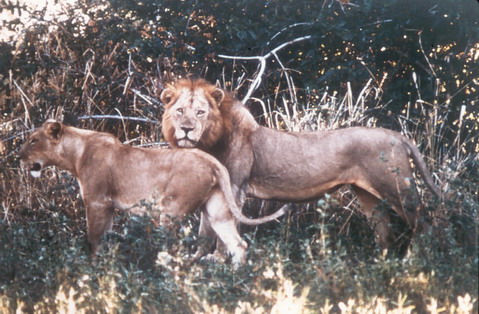
Not more than 100 metres upstream we walked into three big male lion. At a distance of 60 metres we peered over the top of a termite mound to be met by the lions' intense gaze. One of them took umbrage at our presence and in a characteristic manner let us know in no uncertain terms that we weren't welcome, with a bone chilling growl and swishing of tail. It was an unforgettable scene with us on foot, the lions staring at us, and two herds of elephant in the background. With, needless to say, a spurt of adrenaline, we circumvented the lions, walked down into the river bed between the two herds of elephant and continued our walk through the Garden of Eden towards the campsite.
The approach to the site could not have been better scripted - with the bright yellow flush of Long Pod Cassia tree flowers in stark contrast to a cobalt blue sky, the golden rays of the sunset highlighted a large herd of impala whilst baboons played in the Tamarind tree and yet another lone Eland bull browsed on Bush-willow. To cap the walk off, we spotted a beautiful bull Cookson's wildebeest running in the distance, stopping to look back at us before continuing his rocking gait through the Leadwood forest.
The site of our camp was on a bend in the river, out on the white sand beneath a couple of Red Mahoganies. Bedding consisted of bed rolls, mattress, and a couple of sheets and blankets. It was the duty of each guest to make his bed in the dry river bed - done with banter, a couple of beers and much fervour due to the impending darkness. Fires were lit all round and popcorn prepared and washed down with more beer - we were settled in for the night!
Cooking Dinner Dinner consisted of an aperitif of borevors followed by a main course of marinated steak on the fire, potatoes and honey glazed carrots cooked in the coals with a chilli, tomato and onion sauce. Naturally red wine was the choice of beverage! The campfire stories unfolded with much aplomb and amusement. Everyone settled down with their backs against an old Leadwood trunk watching bush TV (the fire) whilst the night came alive around us, with the ever-present sounds of frogs and crickets, the whooping sounds of Hyena in the distance and the distinctive dueting shrill of the diminutive African Scops owl above.
As eyelids drooped we headed for the bedrolls, except for the indomitable figure of John the scout along with Abe who continued to stoke the fires and keep watch for any unwanted visitors. As the breeze died down we were woken by the whine of mosquitoes so deployed the nets and recommenced our dreams in this truly remote wilderness far from the madding crowd.
Morning Camp We awoke in the early morning to the snort of impala and bark of baboon - possibly a leopard moving across the river bed. The coals were stoked and a kettle put on to boil for tea and coffee all round accompanied by the retelling of the mosquito and hyena exploits of the night. After a quick mouthful of biscuit and fruit we proceeded to pack up camp, dousing the fires so as to leave no sign of our stay other than footprints, and then set out for Nsolo camp. On the way, signs of honey badger, civet and hyena gave the group an insight into the activities of our nocturnal friends. Fresh lion droppings and a sighting of eight hyena on the plain in front of Nsolo told us another story of what had happened during the night under the same sky. And then on to Nsolo for a full English breakfast and to recount the experiences and stories of our return to the wild!
Dave Wilson
Saturday, March 1, 2008
Obituary: Norman Carr
Norman Carr is a name inextricably linked to the Luangwa Vally, this obituary can be read in its original form following the link at the end of the article.
Norman Carr shot his 50th elephant on his 20th birthday when he was a government elephant control officer in Northern Rhodesia. It was a dangerous but necessary job, for the local tribes depended on what they grew and, if marauding elephants destroyed the crops, the villagers faced hunger and real hardship. Carr was one of four such officers in the country. Of the other three, one died of drink, one after being mauled by a lion and the tombstone of the third reads "Killed by his 350th elephant".
Like the children of many British parents working in the colonies, Carr was sent to England to be educated when he was just six years old. He didn't see his beloved Africa or his parents again until he was 17, when he worked briefly in his father's tobacco business in Blantyre, Nyasaland, before taking the first opportunity offered to get out into the bush. He was appointed to the Game and Tsetse Department of Northern Rhodesia in 1935, as an elephant control officer.
A formidable hunter, Carr was slight of stature, but he was tough and intrepid. "You don't really know a country until you've walked it," he declared as he set out to cover Rhodesia on foot, walking alone for months with just a few tea-bags and some quinine in his knapsack. He lived off the land as he went, gathering the knowledge which would later enable him to set up National Parks for the Rhodesian government and personally train the rangers and wardens.
After serving as an officer with the King's African Rifles in North Africa during the Second World War, Carr returned to Rhodesia with a new idea - perhaps it would be possible for villagers to make money out of protecting, rather than killing, elephants and other animals. He realised that, to make such a scheme work, the people on the land would have to benefit directly.
He spoke to Paramount Chief Nsefu in the Northern Province, who was mystified as to why people would want to pay to watch animals but was willing to try the experiment. In 1950, having built six simple rondevaals (mud huts) for overnight shelter, Carr brought the first visitors from Chipeta, a town 100 miles away.
They shot with cameras instead of rifles and during the first year paid the chief and his council the then substantial sum of pounds 100 for the privilege. Eco-tourism in Africa was born.
The first National Park Carr established was Kafue, where he became warden. Matching the example being set by Joy and George Adamson, he rehabilitated back into the wild lion cubs whose mother had been shot.
Although the cubs learnt to kill and live off their hunting, the experiment was perhaps not altogether successful. When Northern Rhodesia became the independent Republic of Zambia in 1964, Carr had no difficulty in deciding to stay on: he remembered with distress his early banishment to a country with very little sunshine or space.
Not that Zambia was without its frustration. "Bureaucracy thrives and there is no word for maintenance in any of the local languages. But if I get fed up," he said, "I just remember Regent Street with all its noise and pollution. That calms me down."
Carr wrote several books, all illustrating his love and knowledge of Zambia. The first three, Return to the Wild (1962), The White Impala (1969) and Valley of the Elephants (1972) were published in the UK and the last, Kakuli was published last year in Zimbabwe. Kakuli is the affectionate name by which the locals called him - it means "Old Buffalo".
His success in setting up the National Parks was in part due to the good relationship Carr developed with the Rhodesian and later the Zambian government. He had befriended Kenneth Kaunda and introduced him to the richness of the country's wildlife before he became president in 1964.
Kaunda had a small lodge in the Luangwa Valley and continued to visit Carr regularly. Prince Andrew, the Duke of Edinburgh and Prince Bernhard of the Netherlands were also visitors. The Luangwa Valley National Park, which Carr established and worked in from 1960, is rich in game and it was there, after he retired from the Game Department, that he chose to live and set up Kapani, his own tourist camp just outside the park gates, situated by an oxbow lagoon.
During the day the birdlife on the water is a never-ending fascination. At night, elephants, lions and giraffes often visit the camp and the dawn chorus is always aided by the raucous honking of hippos.
He also had a small camp deep in the bush for serious walkers. There the huts were so flimsy that when you lay in bed you could hear the lions breathing as they padded around exploring the human smells.
At the camp one Christmas morning, Carr took out a family on foot while the cook prepared dinner. They stumbled on a lioness with cubs and had to beat a hasty retreat up a tree while she paced angrily below. They were trapped for hours until a rescue party found them.
He received a card every year thereafter from the family "in remembrance of the most exciting Christmas we have ever spent". Going out on safari with Norman Carr was always an exciting adventure. His vast knowledge and experience meant he could sense in advance what was going on so he might take you in the evening to where 50 elephant were fording the river to seek better feeding ground; the babies completely submerged held their trunks aloft like snorkels.
But the Luangwa Valley is still a wild land with ever-present dangers and Carr never underestimated them nor was he too proud to beat a retreat. Alarm at the devastation caused in Africa by poachers prompted Carr to set up the Rhino Trust in 1970 which later passed into the care of the Worldwide Fund for Nature.
After he was appointed MBE for his life's work, Carr suggested the conservation award should really have gone to the tsetse fly. In areas from which the fly had been banished, cattle are brought in to graze and people take over. Where the tsetse fly continues to flourish so does wildlife.
Carr was determined that tourism should not corrupt the local villagers and although he gladly took visitors right into the poorest areas, he would never allow tipping. However he encouraged donations for the local school which he sponsored, paying for uniforms, books and sports equipment.
Twice a month he took parties of school children into the park to show them their heritage and teach them the names of the animals so they no longer called them all "inama" which means "meat". It is to this Kapani School Fund that donations in memory of Norman Carr are being directed.
Norman Joseph Carr, conservationist: born Chinde, Portuguese East Africa 19 July 1912; married 1940 Barbara Lennon (one son, two daughters); died Johannesburg 1 April 1997.
http://findarticles.com/p/articles/mi_qn4158/is_19970520/ai_n14110579
Subscribe to:
Posts (Atom)